Iothalamic Acid
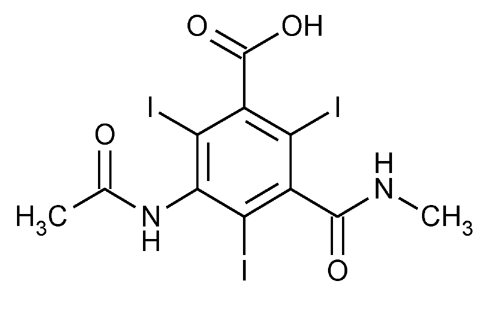
 613.91
Benzoic acid, 3-(acetylamino)-2,4,6-triiodo-5-[(methylamino)carbonyl]-.
5-Acetamido-2,4,6-triiodo-N-methylisophthalamic acid
[2276-90-6].» Iothalamic Acid contains not less than 98.0 percent and not more than 102.0 percent of C11H9I3N2O4, calculated on the anhydrous basis.
Packaging and storage—
Preserve in well-closed containers. Store at 25 , excursions permitted between 15 and 30.
, excursions permitted between 15 and 30.
USP Reference standards  11
11 —
—
USP 5-Amino-2,4,6-triiodo-N-methylisophthalamic Acid RS.
USP Iothalamic Acid RS.
11—
USP 5-Amino-2,4,6-triiodo-N-methylisophthalamic Acid RS.
USP Iothalamic Acid RS.
Identification—
B:
Heat about 500 mg in a suitable crucible: violet vapors are evolved.
Water, Method I 921:
not more than 1.0%.
921:
not more than 1.0%.
Residue on ignition 281:
not more than 0.1%.
281:
not more than 0.1%.
Free aromatic amine—
Dissolve 10.0 g of Iothalamic Acid in a minimal amount of 1 N sodium hydroxide in a 150-mL beaker, add 75 mL of water, and adjust with 1 N sulfuric acid to a pH of 7 ± 0.1. Transfer the solution to a 100-mL cylinder, dilute with water to 100 mL, and mix. Pipet 5 mL of this solution into a 50-mL volumetric flask, and add 10 mL of water. In another flask place 15 mL of water to provide a blank, and to a third flask add 12.5 mL of water and 2.5 mL of a Standard solution prepared as follows. Dissolve 25.0 mg of USP 5-Amino-2,4,6-triiodo-N-methylisophthalamic Acid RS, accurately weighed, in a mixture of 0.5 mL of 1 N sodium hydroxide and 2.5 mL of water in a 250-mL beaker, swirling to effect solution, then add 225 mL of water, mix, adjust with 1 N sulfuric acid to a pH of 7 ± 0.1, transfer to a 250-mL volumetric flask, add water to volume, and mix. Place the three flasks containing the solutions from the substance under test, the Standard solution, and the blank, respectively, in an ice bath. [note—In conducting the following steps, keep the flasks in the ice bath and in the dark as much as possible, until all of the reagents have been added. Chill all reagents and the diluting water to about 5 prior to addition.] Treat each flask as follows. Add 5 mL of freshly prepared sodium nitrite solution (1 in 200), immediately add 10 mL of 1 N hydrochloric acid, and swirl gently to mix. [note—Disregard any precipitate that may be formed at this point.] Allow to stand for 2 minutes, accurately timed. Add 10 mL of ammonium sulfamate solution (1 in 50), and shake frequently during 5 minutes. Five minutes after the addition of the ammonium sulfamate solution, add 3 drops of a 1 in 10 solution of 1-naphthol in alcohol. Mix, and allow to stand for 1 minute. Add 3.5 mL of a pH 10 buffer (made by dissolving 67.5 g of ammonium chloride in 300 mL of water, adding 570 mL of ammonium hydroxide, and diluting with water to 1 L). Mix, remove from the ice bath, and immediately dilute, with water that has been chilled to 5, to volume. Within 20 minutes of diluting the contents of all three flasks to 50 mL, concomitantly determine the absorbances of the test solution and the Standard solution in 1-cm cells at the wavelength of maximum absorbance at about 485 nm, with a suitable spectrophotometer, versus the prepared blank. The absorbance of the solution from the Iothalamic Acid is not greater than that of the Standard solution (0.05%).
prior to addition.] Treat each flask as follows. Add 5 mL of freshly prepared sodium nitrite solution (1 in 200), immediately add 10 mL of 1 N hydrochloric acid, and swirl gently to mix. [note—Disregard any precipitate that may be formed at this point.] Allow to stand for 2 minutes, accurately timed. Add 10 mL of ammonium sulfamate solution (1 in 50), and shake frequently during 5 minutes. Five minutes after the addition of the ammonium sulfamate solution, add 3 drops of a 1 in 10 solution of 1-naphthol in alcohol. Mix, and allow to stand for 1 minute. Add 3.5 mL of a pH 10 buffer (made by dissolving 67.5 g of ammonium chloride in 300 mL of water, adding 570 mL of ammonium hydroxide, and diluting with water to 1 L). Mix, remove from the ice bath, and immediately dilute, with water that has been chilled to 5, to volume. Within 20 minutes of diluting the contents of all three flasks to 50 mL, concomitantly determine the absorbances of the test solution and the Standard solution in 1-cm cells at the wavelength of maximum absorbance at about 485 nm, with a suitable spectrophotometer, versus the prepared blank. The absorbance of the solution from the Iothalamic Acid is not greater than that of the Standard solution (0.05%).
Iodine and iodide—
Test solution—
To 10.0 g in a 50-mL beaker add 16 mL of 1 N sodium hydroxide, and stir until solution is complete. Dilute with water to about 35 mL, and adjust the solution to a pH of between 7.0 and 7.5 with 0.1 N sodium hydroxide or 0.1 N hydrochloric acid. Dilute with water to 50 mL.
Procedure—
Dilute 10 mL of Test solution with 20 mL of water in a 50-mL beaker, add 5 mL of 2 N sulfuric acid, stir, and filter into a glass-stoppered, 50-mL cylinder. To the filtrate add 5 mL of toluene, and shake: the toluene layer shows no red color. Add 1 mL of sodium nitrite solution (1 in 50), and shake: any red color in the toluene layer is not darker than that obtained when a mixture of 2 mL of potassium iodide solution (1 in 4000) and 22 mL of water is substituted for the solution under test (0.02% of iodide).
Heavy metals 231—
To a 50-mL color-comparison tube transfer 5.0 mL of solution prepared as directed for Test solution in the test for Iodine and iodide, add 5 mL of 1 N sodium hydroxide, dilute with water to 40 mL, and mix. Using this as the Test preparation, proceed as directed in the test for Heavy metals under Diatrizoate Meglumine: the limit is 0.002%.
231—
To a 50-mL color-comparison tube transfer 5.0 mL of solution prepared as directed for Test solution in the test for Iodine and iodide, add 5 mL of 1 N sodium hydroxide, dilute with water to 40 mL, and mix. Using this as the Test preparation, proceed as directed in the test for Heavy metals under Diatrizoate Meglumine: the limit is 0.002%.
Assay—
Transfer about 400 mg of Iothalamic Acid, accurately weighed, to a glass-stoppered, 125-mL conical flask, add 12 mL of 5 N sodium hydroxide, 20 mL of water, and 1 g of powdered zinc, connect the flask to a reflux condenser, and reflux for 30 minutes. Cool the flask to room temperature, rinse the condenser with 20 mL of water, disconnect the flask from the condenser, and filter the mixture. Rinse the flask and the filter thoroughly, adding the rinsings to the filtrate. Add 40 mL of 2 N sulfuric acid, and titrate immediately with 0.05 N silver nitrate VS, determining the endpoint potentiometrically, using silver-calomel electrodes and an agar-potassium nitrate salt bridge. Each mL of 0.05 N silver nitrate is equivalent to 10.23 mg of C11H9I3N2O4.
Auxiliary Information—
Please check for your question in the FAQs before contacting USP.
| Topic/Question | Contact | Expert Committee |
| Monograph | Ian DeVeau, Ph.D.
Director, Veterinary Drugs and Radiopharmaceuticals 1-301-816-8178 |
(RMI05) Radiopharmaceuticals and Medical Imaging Agents 05 |
| Reference Standards | Lili Wang, Technical Services Scientist 1-301-816-8129 RSTech@usp.org |
USP32–NF27 Page 2676
Pharmacopeial Forum: Volume No. 29(6) Page 1910