Iohexol
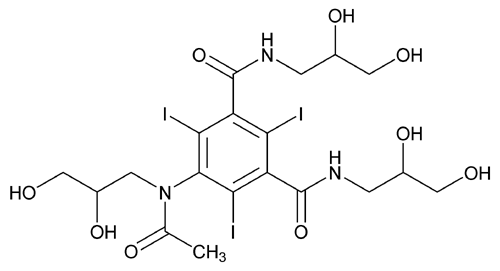
 821.14
1,3-Benzenedicarboxamide, 5-[acetyl(2,3-dihydroxypropyl)amino]-N,N¢-bis(2,3-dihydroxypropyl)-2,4,6-triiodo.
N,N¢-Bis(2,3-dihydroxypropyl)-5-[N-(2,3-dihydroxypropyl)acetamido]-2,4,6-triiodoisophthalamide
[66108-95-0].» Iohexol contains not less than 98.0 percent and not more than 102.0 percent of C19H26I3N3O9, calculated on the anhydrous basis.
Packaging and storage—
Preserve in well-closed, light-resistant containers. Store at 25 , excursions permitted between 15 and 30.
, excursions permitted between 15 and 30.
USP Reference standards  11
11 —
—
USP Iohexol RS .
.
USP Iohexol Related Compound A RS .
USP Iohexol Related Compound B RS .
USP Iohexol Related Compound C RS .
11—
USP Iohexol RS
.
USP Iohexol Related Compound A RS
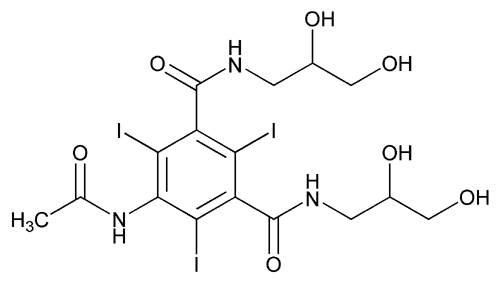 .
.
USP Iohexol Related Compound B RS
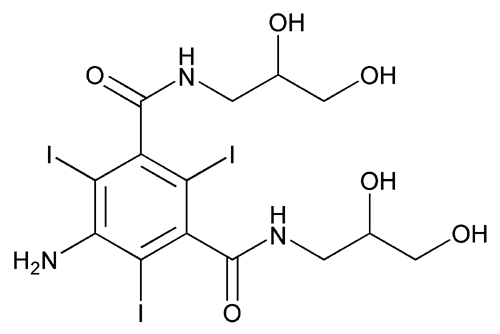 .
.
USP Iohexol Related Compound C RS
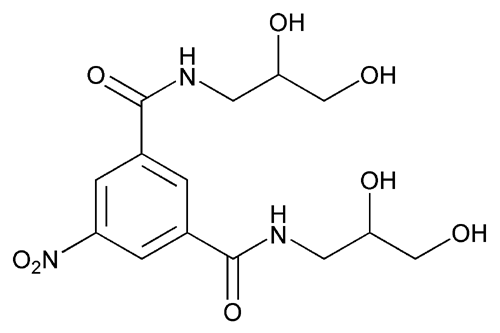 .
.
Color of solution—
Transfer 16.18 g to a 25-mL volumetric flask, dilute with water to volume, and mix. Pass through a filter having a porosity of 0.22 µm. The absorbances of this solution, determined in 1-cm cells at 400 nm, 420 nm, and 450 nm, with a suitable spectrophotometer and using water as the blank, are not greater than 0.180, 0.030, and 0.015, respectively.
Identification—
A:
The IR absorption spectrum of a potassium bromide dispersion of it exhibits maxima only at the same wavelengths as that of a similar preparation of USP Iohexol RS.
B:
The UV absorption spectrum of a 1 in 100,000 solution in water exhibits a maximum and a minimum at the same wavelengths as that of a similar solution of USP Iohexol RS, concomitantly measured.
C:
It responds to the Thin-layer Chromatographic Identification Test 201, the test solution and the Standard solution of USP Iohexol RS being prepared at a concentration of 10 mg per mL in methanol, the solvent system being a mixture of n-butyl alcohol, water, and glacial acetic acid (50:25:11), and short-wavelength UV light being used to locate the spots. The presence of exo- and endo-isomers in the test solution is shown by the appearance of two spots, each of which corresponds in size and intensity to the corresponding principal spot, at the same RF value from the Standard solution. The spot having the RF value is the endo-isomer.
201, the test solution and the Standard solution of USP Iohexol RS being prepared at a concentration of 10 mg per mL in methanol, the solvent system being a mixture of n-butyl alcohol, water, and glacial acetic acid (50:25:11), and short-wavelength UV light being used to locate the spots. The presence of exo- and endo-isomers in the test solution is shown by the appearance of two spots, each of which corresponds in size and intensity to the corresponding principal spot, at the same RF value from the Standard solution. The spot having the RF value is the endo-isomer.
D:
Heat about 500 mg in a crucible: violet vapors are evolved.
Water, Method I 921:
not more than 4.0%.
921:
not more than 4.0%.
Heavy metals, Method I 231:
0.002%.
231:
0.002%.
Free aromatic amine—
Transfer 200 mg to a 50-mL volumetric flask, add 15 mL of water, and mix to dissolve. To a second 50-mL volumetric flask transfer 5 mL of water and 10.0 mL of a Standard solution prepared by dissolving an accurately weighed quantity of USP Iohexol Related Compound B RS in water to obtain a solution having a known concentration of 10 µg per mL. To a third 50-mL volumetric flask add 15 mL of water to provide a blank. Place the three flasks in an ice bath, and chill for 5 minutes. [note—In conducting the following steps, keep the flasks in the ice bath as much as possible until all of the reagents have been added.] Treat each flask as follows. Add 3.0 mL of 5 N hydrochloric acid, and swirl to mix. Add 2.0 mL of sodium nitrite solution (1 in 50), mix, and allow to stand for 4 minutes. Add 2.0 mL of sulfamic acid solution (1 in 25), shake, and allow to stand for 1 minute. [Caution—Considerable pressure is produced.
]
Remove the flasks from the ice bath. To each flask add 2.0 mL of a freshly prepared 1 in 1000 solution of N-(1-naphthyl)ethylenediamine dihydrochloride in dilute propylene glycol (7 in 10), and mix. Dilute with water to volume, mix, and allow to stand for 5 minutes.
Concomitantly determine the absorbances of the test solution and the Standard solution in 5-cm cells at the wavelength of maximum absorbance at about 495 nm, with a suitable spectrophotometer, against the blank. The absorbance of the solution from the Iohexol is not greater than that of the Standard solution (0.05%).
Free iodine—
Transfer 2.1 g to a 50-mL centrifuge tube provided with a stopper, add 20 mL of water, and shake vigorously to dissolve. [note—The solution may be heated gently to assist in dissolving the sample. Cool to room temperature before proceeding.] Add 5.0 mL of toluene and 5 mL of 2 N sulfuric acid, shake, and centrifuge at high speed for 15 minutes: the toluene layer shows no red or pink color.
Free iodide—
Transfer 5.0 g to a suitable container, add about 20 mL of water to dissolve, and titrate with 0.001 N silver nitrate VS using a silver electrode in combination with an appropriate reference electrode, determining the endpoint potentiometrically. Each mL of 0.001 N silver nitrate is equivalent to 126.9 µg of I (0.001%).
Ionic compounds—
[note—Rinse all glassware five times with distilled water.] Measure the specific resistance, (Rsp), at 20 of a solution in water (1 in 50), using a suitable water purity meter. Calculate the specific conductance,  , taken by the formula:
of a solution in water (1 in 50), using a suitable water purity meter. Calculate the specific conductance, , taken by the formula:
(1/Rsp)106.
The specific conductance of the solution is not greater than that of a 0.0002% solution of sodium chloride (equivalent to 0.01% ionic compounds).
Limit of methanol, isopropyl alcohol, and methoxyethanol—
Internal standard solution—
Prepare a solution of secondary butyl alcohol in water containing about 0.05 mg per mL.
Reference solution 1—
Transfer about 0.6 g of methanol, accurately weighed, to a 1000-mL volumetric flask, add about 100 mL of water, and mix. Add about 0.6 g of isopropyl alcohol, accurately weighed, and about 100 mL of water, and mix. Add 0.6 g of methoxyethanol, accurately weighed, and about 100 mL of water, and mix. Dilute with water to volume, and mix.
Reference solution 2—
Transfer 10.0 mL of Reference solution 1 to a 50-mL volumetric flask, dilute with water to volume, and mix. Transfer 10.0 mL of the solution so obtained to a 100-mL volumetric flask, dilute with water to volume, and mix.
Reference solution 3—
Transfer 5.0 mL of Reference solution 1 to a 100-mL volumetric flask, dilute with water to volume, and mix.
Reference solution 4—
Transfer 10.0 mL of Reference solution 1 to a 100-mL volumetric flask, dilute with water to volume, and mix.
Reference solution 5—
Transfer 10.0 mL of Reference solution 4 and 10.0 mL of Internal standard solution to a 50-mL volumetric flask, dilute with water to volume, and mix. Transfer 6.0 mL of the solution so obtained to a vial fitted with a septum and crimp cap, and seal. Heat the sealed vial at 95 for 15 minutes.
for 15 minutes.
Test solution 1—
Transfer about 6.25 g of Iohexol, accurately weighed, to a 25-mL volumetric flask. Add 5.0 mL of Internal standard solution, dilute with water to volume, and mix.
Test solution 2—
Transfer 5.0 mL of Test solution 1 and 1.0 mL of water to a vial fitted with a septum and crimp cap, and seal. Heat the sealed vial at 95 for 15 minutes.
for 15 minutes.
Test solution 3—
Transfer 5.0 mL of Test solution 1 and 1.0 mL of Reference solution 2 to a vial fitted with a septum and crimp cap, and seal. Heat the sealed vial at 95 for 15 minutes.
for 15 minutes.
Test solution 4—
Transfer 5.0 mL of Test solution 1 and 1.0 mL of Reference solution 3 to a vial fitted with a septum and crimp cap, and seal. Heat the sealed vial at 95 for 15 minutes.
for 15 minutes.
Test solution 5—
Transfer 5.0 mL of Test solution 1 and 1.0 mL of Reference solution 4 to a vial fitted with a septum and crimp cap, and seal. Heat the sealed vial at 95 for 15 minutes.
for 15 minutes.
Chromatographic system (see Chromatography 621)—
The gas chromatograph is equipped with a flame-ionization detector and a 0.53-mm × 30-m fused-silica column coated with a 3-µm phase G43. The carrier gas is helium, flowing at a rate of about 14 mL per minute. The chromatograph is programmed as follows. Initially the column temperature is equilibrated at 40 for 5 minutes, then the temperature is increased at a rate of 10 per minute to 100, and is maintained at that temperature for 1 minute. The injection port and detector temperatures are maintained at 140 and 250, respectively. Inject the headspace from Reference solution 5 into the chromatograph, and record the peak responses as directed for Procedure: the relative retention times are about 0.3 for methanol, 0.5 for isopropyl alcohol, 1.0 for secondary butyl alcohol, and 1.3 for methoxyethanol; the resolution, R, between methanol and isopropyl alcohol is not less than 2.5; and the relative standard deviation determined from individual peak responses from replicate injections is not more than 5%.
621)—
The gas chromatograph is equipped with a flame-ionization detector and a 0.53-mm × 30-m fused-silica column coated with a 3-µm phase G43. The carrier gas is helium, flowing at a rate of about 14 mL per minute. The chromatograph is programmed as follows. Initially the column temperature is equilibrated at 40 for 5 minutes, then the temperature is increased at a rate of 10 per minute to 100, and is maintained at that temperature for 1 minute. The injection port and detector temperatures are maintained at 140 and 250, respectively. Inject the headspace from Reference solution 5 into the chromatograph, and record the peak responses as directed for Procedure: the relative retention times are about 0.3 for methanol, 0.5 for isopropyl alcohol, 1.0 for secondary butyl alcohol, and 1.3 for methoxyethanol; the resolution, R, between methanol and isopropyl alcohol is not less than 2.5; and the relative standard deviation determined from individual peak responses from replicate injections is not more than 5%.
Procedure—
Using a gas-tight syringe, separately inject equal volumes (about 2 mL) of the headspace of Test solutions 2, 3, 4, 5, and Reference solution 5 into the chromatograph, record the chromatograms, and measure the areas for the major peaks. Calculate the peak area ratio for each analyte to the internal standard. Plot the peak area ratios obtained from the Test solutions against the quantity of each individual analyte standard added per g of Iohexol. Extrapolate the line joining the points until it intercepts the concentration axis. The distance between this point and the intersection of the axis is the concentration, in mg per g, of methanol, isopropyl alcohol, or methoxyethanol in the portion of Iohexol taken. Not more than 0.005% each of methanol and isopropyl alcohol is found; and not more than 0.002% of methoxyethanol is found.
Limit of 3-chloro-1,2-propanediol—
Test solution—
Dissolve about 1 g of Iohexol, accurately weighed, in 1.0 mL of water. Extract 4 times with 2 mL of ethyl acetate, and combine the extracts. Dry the combined extracts with anhydrous sodium sulfate. Filter, and wash the filter with a small amount of ethyl acetate. Combine the wash with the filtrate, and concentrate to a volume of 2.0 mL, using a warm water bath and a stream of nitrogen. Pass this solution through a membrane filter, and use the clear filtrate.
Standard solution—
Quantitatively dissolve an accurately weighed quantity of 3-chloro-1,2-propanediol in ethyl acetate to obtain a solution having a known concentration of about 20 µg per mL.
System suitability solution—
Dissolve 1 g of Iohexol containing less than 5 µg of chloropropanediol in 1 mL of water. Quantitatively dissolve an accurately weighed quantity of 3-chloro-1,2-propanediol in ethyl acetate to obtain a solution having a concentration of about 25 µg per mL. Add 2.0 mL of the ethyl acetate solution to the aqueous solution of Iohexol in a separator, and mix. Transfer the ethyl acetate layer to a separate container, and extract the aqueous layer three additional times with 2 mL of ethyl acetate, combining all four extracts. Dry the combined extracts using anhydrous sodium sulfate. Filter, and wash the filter with a small amount of ethyl acetate. Combine the wash with the filtrate, and concentrate and filter as directed under Test solution.
Chromatographic system (see Chromatography 621)—
The gas chromatograph is equipped with a flame-ionization detector and a 0.32-mm × 30-m fused-silica capillary column bonded with a 1-µm layer of phase G46. The injection port and detector temperatures are maintained at about 230 and 250, respectively. The carrier gas is helium under 760 mm Hg pressure. The column temperature is held at 50 for 2 minutes and is programmed to increase at a rate of 10 per minute to 200. Chromatograph the Standard solution, and record the responses as directed for Procedure: the relative standard deviation of replicate injections is not more than 10%. Chromatograph the System suitability solution, and record the responses as directed for Procedure. Calculate the percentage of 3-chloro-1,2-propanediol in the portion of Iohexol taken by the formula:
621)—
The gas chromatograph is equipped with a flame-ionization detector and a 0.32-mm × 30-m fused-silica capillary column bonded with a 1-µm layer of phase G46. The injection port and detector temperatures are maintained at about 230 and 250, respectively. The carrier gas is helium under 760 mm Hg pressure. The column temperature is held at 50 for 2 minutes and is programmed to increase at a rate of 10 per minute to 200. Chromatograph the Standard solution, and record the responses as directed for Procedure: the relative standard deviation of replicate injections is not more than 10%. Chromatograph the System suitability solution, and record the responses as directed for Procedure. Calculate the percentage of 3-chloro-1,2-propanediol in the portion of Iohexol taken by the formula:
100(ARC / AST)(CST / CRS)
in which ARC is the response of the analyte peak in the chromatogram obtained from the System suitability solution; AST is the response of the analyte peak in the chromatogram obtained from the Standard solution; CST is the concentration of 3-chloro-1,2-propanediol, in µg per mL, in the Standard solution; and CRS is the concentration of 3-chloro-1,2-propanediol, in µg per mL, in the System suitability solution: not less than 60% and not more than 90% of 3-chloro-1,2-propanediol is found.
Procedure—
Inject a volume (about 2 µL) of Test solution into the chromatograph, and record the chromatograms. Measure the areas for the major peaks due to the two chloropropanediol isomers, which elute at about 12 and 12.5 minutes. Calculate the quantity, in µg, of 3-chloro-1,2-propanediol in the portion of Iohexol taken by the formula:
100(ASA / AST)(2CST / R)
in which ASA is the total of the peak responses of the two isomers in the chromatograph obtained from the Test solution; AST is the total of the peak responses of the two isomers in the chromatograph obtained from the Standard solution; CST is the concentration of 3-chloro-1,2-propanediol, in µg per mL, in the Standard solution; and R is the percentage recovery determined under Chromatographic system. Not more than 0.0025% of 3-chloro-1,2-propanediol is found.
Related compounds—
Solution A—
Use acetonitrile.
Solution B—
Use water.
Mobile phase—
Use variable mixtures of a degassed mixture of Solution A and Solution B as directed for Chromatographic system.
System suitability solution—
Dissolve accurately weighed quantities of USP Iohexol RS, USP Iohexol Related Compound A RS, and USP Iohexol Related Compound C RS in water to obtain a solution having known concentrations of about 1.5 mg per mL, 0.0075 mg per mL, and 0.0069 mg per mL, respectively.
Test solution—
Transfer 75.0 mg of Iohexol, accurately weighed, to a 50-mL volumetric flask, dilute with water to volume, and mix.
Chromatographic system (see Chromatography 621)—
The liquid chromatograph is equipped with a 254-nm detector and a 4.6-mm × 25-cm stainless steel column that contains packing L1. The flow rate is about 1 mL per minute. The chromatograph is programmed to provide variable mixtures of Solution A and Solution B: the percentage of Solution A increases from 1% to 13% at a rate of 0.2% per minute. Chromatograph the System suitability solution, and record the peak responses as directed for Procedure: the retention time for the O-alkylated compounds is between 1.1 and 1.4 relative to 1.0 for the exo-isomer of iohexol; the resolution, R, between iohexol related compound A and iohexol related compound C is not less than 20.0; and the peak area of iohexol related compound C is 0.5% ± 0.1% by comparison to the total area of all the peaks in the chromatogram.
621)—
The liquid chromatograph is equipped with a 254-nm detector and a 4.6-mm × 25-cm stainless steel column that contains packing L1. The flow rate is about 1 mL per minute. The chromatograph is programmed to provide variable mixtures of Solution A and Solution B: the percentage of Solution A increases from 1% to 13% at a rate of 0.2% per minute. Chromatograph the System suitability solution, and record the peak responses as directed for Procedure: the retention time for the O-alkylated compounds is between 1.1 and 1.4 relative to 1.0 for the exo-isomer of iohexol; the resolution, R, between iohexol related compound A and iohexol related compound C is not less than 20.0; and the peak area of iohexol related compound C is 0.5% ± 0.1% by comparison to the total area of all the peaks in the chromatogram.
Procedure—
Inject a volume (about 10 µL) of the Test solution into the chromatograph, record the chromatogram, and measure all the peak responses. Calculate the percentage of O-alkylated compounds and any other individual impurity peak, excluding peaks with a retention time between 0.84 (relative to the endo-isomer of iohexol [first main peak]) and the endo-isomer of iohexol, in the portion of Iohexol taken by the formula:
100(ri / rs)
in which ri is the response of each impurity; and rs is the sum of the responses of all of the peaks: not more than 0.1% of any individual impurity is found; not more than 0.6% of O-alkylated compounds is found; and the sum of all impurities, other than O-alkylated compounds, is not more than 0.3%.
Assay—
Transfer about 500 mg of Iohexol, accurately weighed, to a glass-stoppered, 125-mL conical flask. Add 25 mL of 1.25 N sodium hydroxide and 500 mg of powdered zinc, connect the flask to a reflux condenser, and reflux the mixture for 1 hour. Cool the flask to room temperature, rinse the condenser with 20 mL of water, disconnect the flask from the condenser, and filter the mixture. Rinse the flask and the filter thoroughly with small portions of water, adding the rinsings to the filtrate. Add 5 mL of glacial acetic acid, and titrate with 0.1 N silver nitrate VS, determining the endpoint potentiometrically. Each mL of 0.1 N silver nitrate is equivalent to 27.37 mg of C19H26I3N3O9.
Auxiliary Information—
Please check for your question in the FAQs before contacting USP.
Chromatographic Column—
| Topic/Question | Contact | Expert Committee |
| Monograph | Ian DeVeau, Ph.D.
Director, Veterinary Drugs and Radiopharmaceuticals 1-301-816-8178 |
(RMI05) Radiopharmaceuticals and Medical Imaging Agents 05 |
| Reference Standards | Lili Wang, Technical Services Scientist 1-301-816-8129 RSTech@usp.org |
USP32–NF27 Page 2665
Pharmacopeial Forum: Volume No. 29(6) Page 1908
Chromatographic columns text is not derived from, and not part of, USP 32 or NF 27.