Hydrochlorothiazide
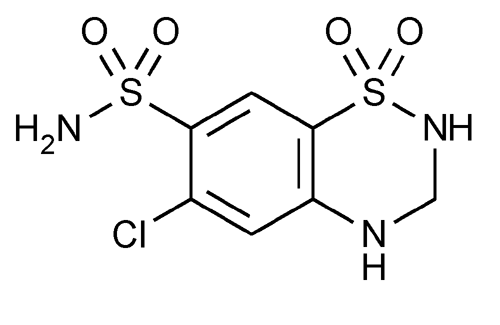
 297.74
2H-1,2,4-Benzothiadiazine-7-sulfonamide, 6-chloro-3,4-dihydro-, 1,1-dioxide.
6-Chloro-3,4-dihydro-2H-1,2,4-benzothiadiazine-7-sulfonamide 1,1-dioxide
[58-93-5].» Hydrochlorothiazide contains not less than 98.0 percent and not more than 102.0 percent of C7H8ClN3O4S2, calculated on the dried basis.
Packaging and storage—
Preserve in well-closed containers.
USP Reference standards  11
11 —
—
USP Benzothiadiazine Related Compound A RS .
.
USP Chlorothiazide RS.
USP Hydrochlorothiazide RS.
11—
USP Benzothiadiazine Related Compound A RS
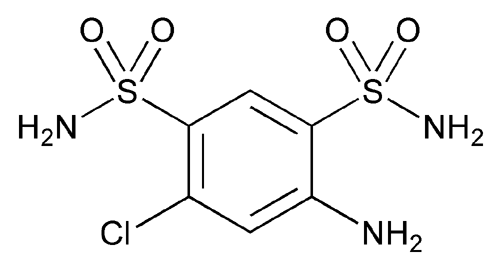 .
.
USP Chlorothiazide RS.
USP Hydrochlorothiazide RS.
Identification—
A:
Infrared Absorption 197K, the potassium bromide-hydrochlorothiazide mixture previously being heated at 105 for 2 hours.
197K, the potassium bromide-hydrochlorothiazide mixture previously being heated at 105 for 2 hours.
Loss on drying 731—
Dry it at 105 for 1 hour: it loses not more than 0.5% of its weight.
731—
Dry it at 105 for 1 hour: it loses not more than 0.5% of its weight.
Residue on ignition 281:
not more than 0.1%.
281:
not more than 0.1%.
Chloride 221—
Shake 0.50 g with 40 mL of water for 5 minutes, and filter: the filtrate shows no more chloride than corresponds to 0.25 mL of 0.020 N hydrochloric acid (0.035%).
221—
Shake 0.50 g with 40 mL of water for 5 minutes, and filter: the filtrate shows no more chloride than corresponds to 0.25 mL of 0.020 N hydrochloric acid (0.035%).
Selenium 291:
0.003%, a 200-mg test specimen being used.
291:
0.003%, a 200-mg test specimen being used.
Heavy metals, Method II 231:
0.001%.
231:
0.001%.
Related compounds—
Diluent, Solution A, Solution B, Mobile phase, and System suitability solution—
Proceed as directed in the Assay.
Quantitation limit solution—
Dissolve an accurately weighed quantity of USP Hydrochlorothiazide RS in Diluent, sonicate if necessary, and dilute quantitatively, and stepwise if necessary, with Diluent to obtain a solution having a known concentration of about 0.16 µg per mL.
Test solution—
Proceed as directed for the Assay preparation in the Assay.
Chromatographic system (see Chromatography 621)—
Prepare as directed in the Assay. Chromatograph the System suitability solution, and record the peak responses as directed for Procedure: the resolution, R, between benzothiadiazine related compound A and chlorothiazide is not less than 2.0 and the resolution, R, between chlorothiazide and hydrochlorothiazide is not less than 1.5; the tailing factor for the benzothiadiazine related compound A, chlorothiazide, and hydrochlorothiazide peaks is not more than 1.5; and the relative standard deviation for replicate injections determined from benzothiadiazine related compound A and chlorothiazide is not more than 5.0%. Chromatograph three replicate injections of the Quantitation limit solution, and record the peak responses as directed for Procedure: the relative standard deviation is not more than 25%. [note—The relative retention times for benzothiadiazine related compound A, chlorothiazide, hydrochlorothiazide, 5-chlorohydrochlorothiazide, and hydrochlorothiazide dimer [6-chloro-N-[(6-chloro-7-sulfamoyl-2,3-dihydro-4H-1,2,4-benzothiadiazine-4-yl 1,1-dioxide)methyl]3,4-dihydro-2H-1,2,4-benzothiadiazine-7-sulfonamide 1,1-dioxide] are about 0.5, 0.8, 1.0, 2.1, and 2.6, respectively.]
621)—
Prepare as directed in the Assay. Chromatograph the System suitability solution, and record the peak responses as directed for Procedure: the resolution, R, between benzothiadiazine related compound A and chlorothiazide is not less than 2.0 and the resolution, R, between chlorothiazide and hydrochlorothiazide is not less than 1.5; the tailing factor for the benzothiadiazine related compound A, chlorothiazide, and hydrochlorothiazide peaks is not more than 1.5; and the relative standard deviation for replicate injections determined from benzothiadiazine related compound A and chlorothiazide is not more than 5.0%. Chromatograph three replicate injections of the Quantitation limit solution, and record the peak responses as directed for Procedure: the relative standard deviation is not more than 25%. [note—The relative retention times for benzothiadiazine related compound A, chlorothiazide, hydrochlorothiazide, 5-chlorohydrochlorothiazide, and hydrochlorothiazide dimer [6-chloro-N-[(6-chloro-7-sulfamoyl-2,3-dihydro-4H-1,2,4-benzothiadiazine-4-yl 1,1-dioxide)methyl]3,4-dihydro-2H-1,2,4-benzothiadiazine-7-sulfonamide 1,1-dioxide] are about 0.5, 0.8, 1.0, 2.1, and 2.6, respectively.]
Procedure—
Inject a volume (about 10 µL) of the Test solution into the chromatograph, record the chromatogram, and measure the peak responses. Calculate the percentage of each impurity in the portion of Hydrochlorothiazide taken by the formula:
100(ric / rsc)
in which ric is the ratio of the peak area for each impurity to its response factor; and rsc is the sum of ratios of all the peak areas to their respective response factors, the response factors being 0.54, 0.63, and 1.0 for benzothiadiazine related compound A, chlorothiazide, and all other peaks, respectively: not more than 1.0% of benzothiadiazine related compound A is found; not more than 0.5% of any other impurity is found; and not more than 0.9% of total other impurities excluding benzothiadiazine related compound A is found.
Assay—
Sodium phosphate solution—
Transfer 2.76 g of monobasic sodium phosphate, accurately weighed, into a 1000-mL volumetric flask, and add about 990 mL of water. Adjust with phosphoric acid to a pH of 2.7 ± 0.1, and dilute with water to volume. Make adjustments if necessary (see System Suitability under Chromatography 621).
621).
Diluent—
Prepare a mixture of Sodium phosphate solution and acetonitrile (7:3).
Solution A—
Prepare and degas a mixture of acetonitrile and methanol (3:1).
Solution B—
Prepare and degas a solution of anhydrous formic acid in water (5 in 1000).
Mobile phase—
Use variable mixtures of Solution A and Solution B as directed for Chromatographic system. Make adjustments if necessary (see System Suitability under Chromatography 621).
621).
System suitability solution—
Dissolve suitable quantities of USP Hydrochlorothiazide RS, USP Chlorothiazide RS, and USP Benzothiadiazine Related Compound A RS in Diluent, sonicate if necessary, and dilute with Diluent to obtain a solution containing about 0.32 mg per mL, 0.0032 mg per mL, and 0.0032 mg per mL, respectively. Pass a portion through a filter having a 0.45-µm or finer porosity.
Standard preparation—
Dissolve an accurately weighed quantity of USP Hydrochlorothiazide RS in Diluent, sonicate if necessary, and dilute quantitatively, and stepwise if necessary, with Diluent to obtain a solution having a known concentration of about 0.32 mg per mL. Pass a portion through a filter having a 0.45-µm or finer porosity before injection.
Assay preparation—
Transfer about 32 mg of Hydrochlorothiazide, accurately weighed, to a 100-mL volumetric flask. Add about 70 mL of Diluent, sonicate for 10 minutes if necessary to dissolve, and allow to cool to ambient temperature. Dilute with Diluent to volume, mix, and pass a portion through a filter having a 0.45-µm or finer porosity before injection.
Chromatographic system (see Chromatography 621)—
The liquid chromatograph is equipped with a 275-nm detector and 4.6-mm × 5-cm column that contains 3.5-µm packing L1. The flow rate is about 1.0 mL per minute. The column temperature is maintained at 35. The chromatograph is programmed as follows.
Chromatograph the Diluent to check for interference by system related peaks. Chromatograph the System suitability solution, and record the peak responses as directed for Procedure: the relative retention times are about 0.5 for benzothiadiazine related compound A, 0.8 for chlorothiazide, and 1.0 for hydrochlorothiazide; the resolution, R, between benzothiadiazine related compound A and chlorothiazide is not less than 2.0 and the resolution, R, between chlorothiazide and hydrochlorothiazide is not less than 1.5; and the tailing factor for the benzothiadiazine related compound A, chlorothiazide, and hydrochlorothiazide peaks is not more than 1.5. Chromatograph the Standard preparation, and record the peak responses as directed for Procedure: the relative standard deviation for replicate injections is not more than 1.0%.
621)—
The liquid chromatograph is equipped with a 275-nm detector and 4.6-mm × 5-cm column that contains 3.5-µm packing L1. The flow rate is about 1.0 mL per minute. The column temperature is maintained at 35. The chromatograph is programmed as follows.
| Time (minutes) |
Solution A
(%) |
Solution B
(%) |
Elution |
| 0 | 3 | 97 | equilibration |
| 0–5 | 3 | 97 | isocratic |
| 5–14 | 3®36 | 97®64 | linear gradient |
| 14–18 | 36®3 | 64®97 | linear gradient |
| 18–20 | 3 | 97 | re-equilibration |
Procedure—
Separately inject equal volumes (about 10 µL) of the Standard preparation and the Assay preparation into the chromatograph, record the chromatograms, and measure the responses for the hydrochlorothiazide peaks. Calculate the quantity, in mg, of C7H8ClN3O4S2 in the portion of Hydrochlorothiazide taken by the formula:
100C(rU / rS)
in which C is the concentration, in mg per mL, of USP Hydrochlorothiazide RS in the Standard preparation; and rU and rS are the peak responses obtained from the Assay preparation and the Standard preparation, respectively.
Auxiliary Information—
Please check for your question in the FAQs before contacting USP.
Chromatographic Column—
| Topic/Question | Contact | Expert Committee |
| Monograph | Sujatha Ramakrishna, Ph.D.
Scientist 1-301-816-8349 |
(MDCV05) Monograph Development-Cardiovascular |
| Reference Standards | Lili Wang, Technical Services Scientist 1-301-816-8129 RSTech@usp.org |
USP32–NF27 Page 2566
Pharmacopeial Forum: Volume No. 28(4) Page 1123
Chromatographic columns text is not derived from, and not part of, USP 32 or NF 27.