Ethylparaben

 166.17
Benzoic acid, 4-hydroxy-, ethyl ester.
Ethyl p-hydroxybenzoate
[120-47-8].» Ethylparaben contains not less than 98.0 percent and not more than 102.0 percent of C9H10O3.
Packaging and storage—
Preserve in well-closed containers.
Color of solution—
Dissolve 1 g in alcohol, dilute with alcohol to 10 mL, and mix (Ethylparaben solution). This solution is clear and not more intensely colored than alcohol or a solution prepared immediately before use by mixing 2.4 mL of ferric chloride CS, 1.0 mL of cobaltous chloride CS, and 0.4 mL of cupric sulfate CS with 0.3 N hydrochloric acid to make 10 mL, and diluting 5 mL of this solution with 0.3 N hydrochloric acid to make 100 mL. Make the comparison by viewing the solutions downward in matched color-comparison tubes against a white surface (see Color and Achromicity  631
631 ).
).
631).
Acidity—
To 2 mL of Ethylparaben solution prepared in the Color of solution test add 3 mL of alcohol, 5 mL of carbon dioxide-free water, and 0.1 mL of bromocresol green TS, and titrate with 0.10 N sodium hydroxide: not more than 0.1 mL is required to produce a blue color.
Residue on ignition 281:
not more than 0.1%, determined on 1.0 g.
281:
not more than 0.1%, determined on 1.0 g.
Related substances—
Test solution—
Prepare a solution of Ethylparaben in acetone containing 10 mg per mL.
Standard solutions—
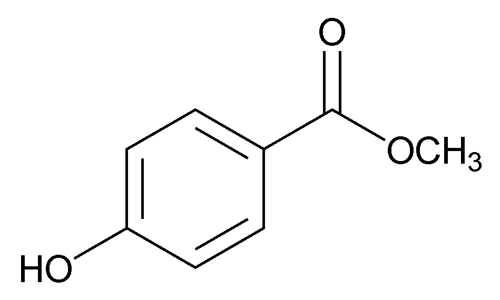
Transfer 0.5 mL of the Test solution to a 100-mL volumetric flask, dilute with acetone to volume, and mix (Standard solution A). Dissolve 10 mg, accurately weighed, of USP Methylparaben RS in 1 mL of the Test solution, and dilute with acetone to 10 mL (Standard solution B).
Procedure—
Separately apply 2 µL of the Test solution and 2 µL of each Standard solution to a thin-layer chromatographic plate (see Chromatography 621), coated with a 0.25-mm layer of chromatographic octadecylsilanized silica gel mixture. Develop the chromatogram in a solvent system consisting of a mixture of methanol, water, and glacial acetic acid (70:30:1) until the solvent front has moved about three-fourths of the length of the plate. Remove the plate from the chamber, mark the solvent front, and allow the solvent to evaporate. Examine the plate under short-wavelength UV light, and compare the intensities of any secondary spots observed in the chromatogram of the Test solution with that of the principal spot in the chromatogram of Standard solution A: the intensity of any individual secondary spot in the chromatogram of the Test solution is not greater than that of the principal spot obtained in the chromatogram of Standard solution A (0.5%). The test is not valid unless the chromatogram obtained with Standard solution B shows two clearly separated principal spots.
621), coated with a 0.25-mm layer of chromatographic octadecylsilanized silica gel mixture. Develop the chromatogram in a solvent system consisting of a mixture of methanol, water, and glacial acetic acid (70:30:1) until the solvent front has moved about three-fourths of the length of the plate. Remove the plate from the chamber, mark the solvent front, and allow the solvent to evaporate. Examine the plate under short-wavelength UV light, and compare the intensities of any secondary spots observed in the chromatogram of the Test solution with that of the principal spot in the chromatogram of Standard solution A: the intensity of any individual secondary spot in the chromatogram of the Test solution is not greater than that of the principal spot obtained in the chromatogram of Standard solution A (0.5%). The test is not valid unless the chromatogram obtained with Standard solution B shows two clearly separated principal spots.
Assay—
Transfer about 1.000 g of Ethylparaben, accurately weighed, to a flask fitted with a ground-glass stopper. Add 20.0 mL of 1 N sodium hydroxide VS, and heat at about 70 for 1 hour. Cool rapidly in an ice bath. Carry out the titration of the solutions at room temperature. Titrate the excess sodium hydroxide with 1 N sulfuric acid VS, continuing the titration until the second point of inflection and determining the endpoint potentiometrically (see Titrimetry 541). Perform a blank determination (see Residual Titrations under Titrimetry 541). Each mL of 1 N sodium hydroxide is equivalent to 166.2 mg of C9H10O3.
for 1 hour. Cool rapidly in an ice bath. Carry out the titration of the solutions at room temperature. Titrate the excess sodium hydroxide with 1 N sulfuric acid VS, continuing the titration until the second point of inflection and determining the endpoint potentiometrically (see Titrimetry 541). Perform a blank determination (see Residual Titrations under Titrimetry 541). Each mL of 1 N sodium hydroxide is equivalent to 166.2 mg of C9H10O3.
Auxiliary Information—
Please check for your question in the FAQs before contacting USP.
Chromatographic Column—
| Topic/Question | Contact | Expert Committee |
| Monograph | Kevin T. Moore, Ph.D.
Scientist 1-301-816-8369 |
(EM105) Excipient Monographs 1 |
| Reference Standards | Lili Wang, Technical Services Scientist 1-301-816-8129 RSTech@usp.org |
USP32–NF27 Page 1236
Pharmacopeial Forum: Volume No. 34(6) Page 1594
Chromatographic columns text is not derived from, and not part of, USP 32 or NF 27.