Colistin Sulfate
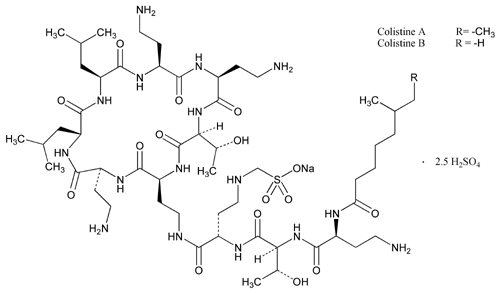
Colistin, sulfate.
Colistins sulfate
 [1264-72-8].
» Colistin Sulfate is the sulfate salt of an antibacterial substance produced by the growth of Bacillus polymyxa var. colistinus. It has a potency equivalent to not less than 500 µg of colistin per mg.
Packaging and storage—
Preserve in tight containers.
Identification—
A:
Dissolve about 20 mg in 2 mL of buffer solution, prepared by adjusting 50 mL of 1 M monobasic potassium phosphate with 1 N sodium hydroxide to a pH of 7.0, diluting with water to 100 mL, and mixing. Add 0.2 mL of ninhydrin solution (1 in 200) and boil: a purple color is produced.
B:
It meets the requirements of the tests for Sulfate  191
191 .
.
191.
C:
Liquid Chromatographic Identification Test—
Mobile phase—
Prepare a mixture of 0.1 M tribasic sodium phosphate and acetonitrile (77:23), and adjust with phosphoric acid to a pH of 3.0. Make adjustments if necessary (see System Suitability under Chromatography 621).
621).
Standard solution—
Prepare a solution of USP Colistin Sulfate RS in Mobile phase having a concentration of about 6 mg per mL. Protect this solution from light.
Test solution—
Prepare a solution of Colistin Sulfate in Mobile phase having a concentration of about 6 mg per mL. Protect this solution from light.
Chromatographic system (see Chromatography 621)—
The liquid chromatograph is equipped with a 212-nm detector and a 4.6-mm × 25-cm column that contains 5-µm packing L1. The flow rate is about 1 mL per minute.
621)—
The liquid chromatograph is equipped with a 212-nm detector and a 4.6-mm × 25-cm column that contains 5-µm packing L1. The flow rate is about 1 mL per minute.
Procedure—
Separately inject equal volumes (about 10 µL) of the Standard solution and the Test solution into the chromatograph, and record the chromatograms. The chromatogram obtained from the Test solution corresponds qualitatively with that obtained from the Standard solution, exhibiting a major peak corresponding to colistin A and minor peaks at relative retention times of about 0.55 (colistin B) and 0.8.
pH 791:
between 4.0 and 7.0, in a solution containing 10 mg per mL.
791:
between 4.0 and 7.0, in a solution containing 10 mg per mL.
Loss on drying 731—
Dry about 100 mg, accurately weighed, in a capillary-stoppered bottle in vacuum at a pressure not exceeding 5 mm of mercury at 60 for 3 hours: it loses not more than 7.0% of its weight.
731—
Dry about 100 mg, accurately weighed, in a capillary-stoppered bottle in vacuum at a pressure not exceeding 5 mm of mercury at 60 for 3 hours: it loses not more than 7.0% of its weight.
Assay—
Proceed as directed for Colistin under Antibiotics—Microbial Assays 81.
81.
Auxiliary Information—
Please check for your question in the FAQs before contacting USP.
Chromatographic Column—
| Topic/Question | Contact | Expert Committee |
| Monograph | Ahalya Wise, M.S.
Scientist 1-301-816-8161 |
(MDANT05) Monograph Development-Antibiotics |
| Reference Standards | Lili Wang, Technical Services Scientist 1-301-816-8129 RSTech@usp.org |
USP32–NF27 Page 2022
Pharmacopeial Forum: Volume No. 28(4) Page 1093
Chromatographic columns text is not derived from, and not part of, USP 32 or NF 27.