Alumina, Magnesia, Calcium Carbonate, and Simethicone Tablets
(Current title—not to change until February 1, 2010)
Monograph title change—to become official February 1, 2010
See Alumina, Magnesia, Calcium Carbonate, and Simethicone Chewable Tablets
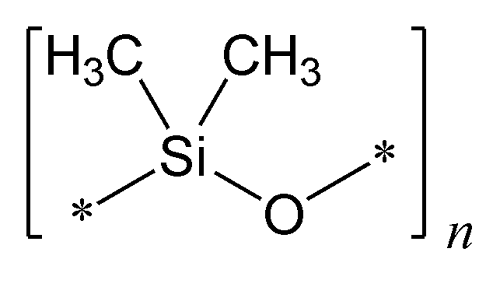
» Alumina, Magnesia, Calcium Carbonate, and Simethicone Tablets contain not less than 90.0 percent and not more than 110.0 percent of the labeled amounts of aluminum hydroxide [Al(OH)3], magnesium hydroxide [Mg(OH)2], and calcium carbonate (CaCO3), and an amount of polydimethylsiloxane ([ (CH3)2SiO]n) that is not less than 85.0 percent and not more than 115.0 percent of the labeled amount of simethicone.
(CH3)2SiO]n) that is not less than 85.0 percent and not more than 115.0 percent of the labeled amount of simethicone.
Packaging and storage—
Preserve in well-closed containers.
Labeling—
The labeling indicates that the Tablets are to be chewed before swallowing. Label the Tablets to state the sodium content, if it is greater than 5 mg per Tablet.
Identification—
A:
Cut a Tablet into pieces, add 50 mL of 1 N sulfuric acid, stir until the pieces disintegrate, and heat on a steam bath for 10 minutes. Cool, add 50 mL of alcohol, and stir. The mixture so obtained responds to Identification tests A, B, and C under Alumina, Magnesia, and Calcium Carbonate Oral Suspension, beginning under Identification test A with “place in an ice bath for 30 minutes.”
B:
Infrared Absorption  197S
197S —
—
197S—
Cell:
0.5 mm.
Solution:
prepared as directed in the Assay for polydimethylsiloxane.
Microbial enumeration tests 61 and Tests for specified microorganisms 62—
The total aerobic microbial count does not exceed 200 cfu per g, the total combined molds and yeasts count does not exceed 200 cfu per g, and the Tablets meet the requirements of the test for the absence of Salmonella species and Escherichia coli.
61 and Tests for specified microorganisms 62—
The total aerobic microbial count does not exceed 200 cfu per g, the total combined molds and yeasts count does not exceed 200 cfu per g, and the Tablets meet the requirements of the test for the absence of Salmonella species and Escherichia coli.
Uniformity of dosage units 905:
meet the requirements for Weight Variation with respect to aluminum hydroxide, to magnesium hydroxide, and to calcium carbonate.
905:
meet the requirements for Weight Variation with respect to aluminum hydroxide, to magnesium hydroxide, and to calcium carbonate.
Acid-neutralizing capacity 301—
Dissolve an accurately counted number of Tablets, equivalent to about 120 mEq of acid-neutralizing capacity, in about 400 mL of water. Transfer the mixture to a 500-mL volumetric flask, dilute with water to volume, and mix. Use 75.0 mL of this solution as the Test preparation. Proceed as directed in the section Procedure for Powders, Effervescent Solids, Suspensions and Other Liquids, Nonchewable Tablets, Chewable Tablets, and Capsules. The acid consumed by the minimum single dose recommended in the labeling is not less than 5 mEq, and not less than the number of mEq calculated by the formula:
301—
Dissolve an accurately counted number of Tablets, equivalent to about 120 mEq of acid-neutralizing capacity, in about 400 mL of water. Transfer the mixture to a 500-mL volumetric flask, dilute with water to volume, and mix. Use 75.0 mL of this solution as the Test preparation. Proceed as directed in the section Procedure for Powders, Effervescent Solids, Suspensions and Other Liquids, Nonchewable Tablets, Chewable Tablets, and Capsules. The acid consumed by the minimum single dose recommended in the labeling is not less than 5 mEq, and not less than the number of mEq calculated by the formula:
0.55(0.0385A) + 0.8(0.0343 M) + 0.9(0.02C)
in which 0.0385, 0.0343, and 0.02 are the theoretical acid-neutralizing capacities, in mEq, of Al(OH)3, Mg(OH)2, and CaCO3, respectively, and A, M, and C are the quantities, in mg, of Al(OH)3, Mg(OH)2, and CaCO3 in the specimen tested, based on the labeled quantities.
Sodium content—
Potassium chloride solution—
Dissolve 3 g of potassium chloride in water in a 100-mL volumetric flask, dilute with water to volume, and mix.
Dilute hydrochloric acid—
Prepare by mixing 226 mL of hydrochloric acid with sufficient water to make 1000 mL.
Standard solution—
Transfer 2.5420 g of sodium chloride, previously dried at 105 for 2 hours, to a 1000-mL volumetric flask, dissolve in and dilute with water to volume, and mix. Transfer 10.0 mL of this solution to a 100-mL volumetric flask, dilute with water to volume, and mix. Transfer 10.0 mL of this solution to a second 100-mL volumetric flask, dilute with water to volume, and mix. To three separate 100-mL volumetric flasks, each containing 10.0 mL of Potassium chloride solution and 3.0 mL of Dilute hydrochloric acid, add, respectively, 10.0, 20.0, and 30.0 mL of this solution. These solutions contain 1.0, 2.0, and 3.0 µg of sodium (Na) per mL, respectively.
for 2 hours, to a 1000-mL volumetric flask, dissolve in and dilute with water to volume, and mix. Transfer 10.0 mL of this solution to a 100-mL volumetric flask, dilute with water to volume, and mix. Transfer 10.0 mL of this solution to a second 100-mL volumetric flask, dilute with water to volume, and mix. To three separate 100-mL volumetric flasks, each containing 10.0 mL of Potassium chloride solution and 3.0 mL of Dilute hydrochloric acid, add, respectively, 10.0, 20.0, and 30.0 mL of this solution. These solutions contain 1.0, 2.0, and 3.0 µg of sodium (Na) per mL, respectively.
Test solution—
Accurately weigh 10 Tablets, and determine the average weight, A, in mg. Cut 4 Tablets into pieces, combine the pieces, and weigh them. Transfer the combined pieces to a 500-mL volumetric flask, add 150 mL of Dilute hydrochloric acid, and swirl gently to disintegrate the pieces. Dilute with water to volume, and mix. Transfer 10.0 mL of this solution to a 100-mL volumetric flask, add 10.0 mL of Potassium chloride solution, dilute with water to volume, and mix.
Blank solution—
Transfer 3.0 mL of Dilute hydrochloric acid and 10.0 mL of Potassium chloride solution to a 100-mL volumetric flask, dilute with water to volume, and mix.
Procedure—
Concomitantly determine the absorbances of the Standard solutions and the Test solution at the sodium emission line at 589.0 nm with a suitable atomic absorption spectrophotometer (see Spectrophotometry and Light-Scattering 851) equipped with a sodium hollow-cathode lamp and an air–acetylene flame, using the Blank solution as the blank. Plot the absorbances of the Standard solutions versus concentration, in µg per mL, of sodium, and draw the straight line best fitting the three plotted points. From the graph so obtained, determine the concentration, C, in µg per mL, of sodium in the Test solution. Calculate the mg of sodium (Na) in each Tablet taken by the formula:
851) equipped with a sodium hollow-cathode lamp and an air–acetylene flame, using the Blank solution as the blank. Plot the absorbances of the Standard solutions versus concentration, in µg per mL, of sodium, and draw the straight line best fitting the three plotted points. From the graph so obtained, determine the concentration, C, in µg per mL, of sodium in the Test solution. Calculate the mg of sodium (Na) in each Tablet taken by the formula:
5C(A/W)
in which A is the average weight, in mg, of each Tablet and W is the weight, in mg, of the portion of Tablets taken to prepare the Test solution. Tablets contain not more than 5 mg of sodium per Tablet, except when labeled as containing more than 5 mg of sodium per Tablet, they contain not more than 110% of the labeled amount.
Assay for aluminum hydroxide—
Assay preparation—
Transfer an accurately counted number of Tablets, equivalent to about 665 mg of aluminum hydroxide, to a suitable beaker. Add 15 mL of hydrochloric acid, and swirl to dissolve the Tablets. Add 80 mL of water, and filter into a 200-mL volumetric flask. Wash the filter with water into the flask, add water to volume, and mix.
Procedure—
Pipet 20 mL of Assay preparation into a 250-mL beaker, then add, in the order named and with continuous stirring, 25.0 mL of Edetate disodium titrant and 20 mL of acetic acid–ammonium acetate buffer TS, and heat near the boiling temperature for 5 minutes. Cool, add 50 mL of alcohol and 2 mL of dithizone TS, and mix. Titrate with 0.05 M zinc sulfate VS until the color changes from green-violet to rose-pink. Perform a blank determination, substituting 20 mL of water for the Assay preparation, and making any necessary correction. Each mL of 0.05 M Edetate disodium titrant consumed is equivalent to 3.900 mg of Al(OH)3.
Assay for magnesium hydroxide—
Lanthanum chloride solution—
Transfer 17.6 g of lanthanum chloride to a 200-mL volumetric flask, add 100 mL of water, and carefully add 50 mL of hydrochloric acid. Mix, and allow to cool. Dilute with water to volume, and mix.
Dilute hydrochloric acid—
Prepare by mixing 226 mL of hydrochloric acid with sufficient water to make 1000 mL.
Potassium chloride solution—
Dissolve 3 g of potassium chloride in water in a 100-mL volumetric flask, dilute with water to volume, and mix.
Magnesium stock solution—
Transfer 1.000 g of magnesium metal to a 1000-mL volumetric flask containing 10 mL of water, slowly add 10 mL of hydrochloric acid, and swirl to dissolve the metal. Dilute with water to volume, and mix. Transfer 2.0 mL of this solution to a 100-mL volumetric flask, dilute with water to volume, and mix. This solution contains 20 µg of magnesium (Mg) per mL.
Standard preparations—
To three separate 100-mL volumetric flasks each containing 5.0 mL of Lanthanum chloride solution, add 1.0, 2.0, and 3.0 mL, respectively, of the Magnesium stock solution. Dilute each with water to volume, and mix. These solutions contain 0.1, 0.2, and 0.3 µg of magnesium (Mg) per mL, respectively.
Assay preparation—
Transfer an accurately counted number of Tablets, equivalent to about 250 mg of magnesium hydroxide (100 mg of magnesium), to a 1000-mL volumetric flask. Add 500 mL of Dilute hydrochloric acid, and swirl to disintegrate the Tablets. Add 100.0 mL of Potassium chloride solution, dilute with water to volume, and mix. Transfer 10.0 mL of this solution to a 100-mL volumetric flask, dilute with water to volume, and mix. Transfer 2.0 mL of this solution to a second 100-mL volumetric flask, add 5.0 mL of Lanthanum chloride solution, dilute with water to volume, and mix.
Blank—
Add 50 mL of Dilute hydrochloric acid and 10.0 mL of Potassium chloride solution to a 100-mL volumetric flask, dilute with water to volume, and mix. Transfer 10.0 mL of this solution to a second 100-mL volumetric flask, dilute with water to volume, and mix. Transfer 2.0 mL of this solution to a third 100-mL volumetric flask, add 5.0 mL of Lanthanum chloride solution, dilute with water to volume, and mix.
Procedure—
Concomitantly determine the absorbances of the Standard preparations and the Assay preparation at the magnesium emission line at 285.2 nm, with a suitable atomic absorption spectrophotometer (see Spectrophotometry and Light-Scattering 851) equipped with a magnesium hollow-cathode lamp and an air–acetylene flame, using the Blank to set the instrument. Plot the absorbances of the Standard preparations versus concentration, in µg per mL, of magnesium, and draw the straight line best fitting the three plotted points. From the graph so obtained, determine the concentration, C, in µg per mL, of magnesium in the Assay preparation. Calculate the quantity, in mg, of magnesium hydroxide [Mg(OH)2] in each Tablet taken by the formula:
851) equipped with a magnesium hollow-cathode lamp and an air–acetylene flame, using the Blank to set the instrument. Plot the absorbances of the Standard preparations versus concentration, in µg per mL, of magnesium, and draw the straight line best fitting the three plotted points. From the graph so obtained, determine the concentration, C, in µg per mL, of magnesium in the Assay preparation. Calculate the quantity, in mg, of magnesium hydroxide [Mg(OH)2] in each Tablet taken by the formula:
(58.34/24.305)(500C/N)
in which 58.34 is the molecular weight of magnesium hydroxide; 24.305 is the atomic weight of magnesium; and N is the number of Tablets taken to prepare the Assay preparation.
Assay for calcium carbonate—
Assay preparation—
Prepare as directed in the Assay for aluminum hydroxide.
Procedure—
Pipet a volume of the Assay preparation, equivalent to about 50 mg of calcium carbonate, into a 400-mL beaker, and add 200 mL of water, a volume of sodium hydroxide solution (1 in 2) equivalent to the volume of the Assay preparation taken, and 250 mg of hydroxy naphthol blue. Stir with a magnetic stirrer, and titrate immediately with 0.05 M edetate disodium VS until the solution is distinctly blue. Perform a blank determination, substituting a volume of water equivalent to the volume of the Assay preparation taken, and make any necessary correction. Each mL of 0.05 M edetate disodium is equivalent to 5.004 mg of CaCO3.
Assay for polydimethylsiloxane—
Dilute hydrochloric acid—
Prepare by mixing 400 mL of hydrochloric acid with sufficient water to make 1000 mL.
Standard preparation—
Transfer about 60 mg of USP Polydimethylsiloxane RS, accurately weighed, to a separator, add 30.0 mL of chloroform and 60 mL of Dilute hydrochloric acid, shake for 30 seconds, and allow the phases to separate. Remove about 10 mL of the lower, organic layer to a screw-capped, 15-mL test tube containing 0.5 g of anhydrous sodium sulfate. Close the tube with a screw-cap having an inert liner, agitate vigorously, and centrifuge the mixture until a clear supernatant is obtained (Standard preparation).
Assay preparation—
Weigh and finely powder not fewer than 20 Tablets. Transfer an accurately weighed portion of the powder, equivalent to about 60 mg of simethicone, to a suitable screw-capped bottle, add 30.0 mL of chloroform and 60 mL of Dilute hydrochloric acid, and allow to stand, with frequent shaking, until the Tablets are dissolved. Transfer the contents of the bottle to a separator, shake, and allow the phases to separate. Remove about 10 mL of the lower, organic layer to a screw-capped, 15-mL test tube containing 0.5 g of anhydrous sodium sulfate. Close the tube with a screw-cap having an inert liner, agitate vigorously, and centrifuge the mixture until a clear supernatant is obtained (Assay preparation).
Blank—
Place 30.0 mL of chloroform and 60 mL of Dilute hydrochloric acid in a separator, shake for 30 seconds, and allow the phases to separate. Remove about 10 mL of the lower, organic layer to a screw-capped, 15-mL test tube containing 0.5 g of anhydrous sodium sulfate. Close the tube with a screw-cap having an inert liner, agitate vigorously, and centrifuge the mixture until a clear supernatant is obtained (Blank).
Procedure—
Concomitantly determine the absorbances of the Standard preparation and the Assay preparation in 0.5-mm cells at the wavelength of maximum absorbance at about 7.9 µm, with a suitable IR spectrophotometer, using the Blank to set the instrument. Calculate the quantity, in mg, of [–(CH3)2SiO–]n in each Tablet taken by the formula:
(W/N)(AU / AS)
in which W is the weight, in mg, of USP Polydimethylsiloxane RS used in preparing the Standard preparation; N is the number of Tablets taken to prepare the Assay preparation; and AU and AS are the absorbances of the Assay preparation and the Standard preparation, respectively.
Auxiliary Information—
Please check for your question in the FAQs before contacting USP.
| Topic/Question | Contact | Expert Committee |
| Monograph | Elena Gonikberg, Ph.D.
Senior Scientist 1-301-816-8251 |
(MDGRE05) Monograph Development-Gastrointestinal Renal and Endocrine |
| Reference Standards | Lili Wang, Technical Services Scientist 1-301-816-8129 RSTech@usp.org |
|
| 61 |
Radhakrishna S Tirumalai, Ph.D.
Senior Scientist 1-301-816-8339 |
(MSA05) Microbiology and Sterility Assurance |
| 62 |
Radhakrishna S Tirumalai, Ph.D.
Senior Scientist 1-301-816-8339 |
(MSA05) Microbiology and Sterility Assurance |
USP32–NF27 Page 1467
Pharmacopeial Forum: Volume No. 33(5) Page 871