Acetaminophen
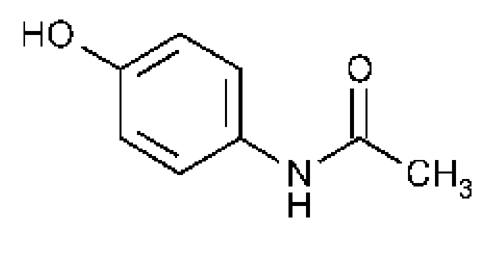
 151.16
Acetamide, N-(4-hydroxyphenyl)-.
4¢-Hydroxyacetanilide
[103-90-2].» Acetaminophen contains not less than 98.0 percent and not more than 101.0 percent of C8H9NO2, calculated on the anhydrous basis.
Packaging and storage—
Preserve in tight, light-resistant containers, and store at room temperature. Protect from moisture and heat.
Identification—
B: Ultraviolet Absorption  197U
197U —
—
197U—
Solution:
5 µg per mL.
Medium:
0.1 N hydrochloric acid in methanol (1 in 100).
C:
It responds to the Thin-layer Chromatographic Identification Test 201, a test solution in methanol containing about 1 mg per mL and a solvent system consisting of a mixture of methylene chloride and methanol (4:1) being used.
201, a test solution in methanol containing about 1 mg per mL and a solvent system consisting of a mixture of methylene chloride and methanol (4:1) being used.
 and 172
Water, Method I 921:
not more than 0.5%.
921:
not more than 0.5%.
Residue on ignition 281:
not more than 0.1%.
281:
not more than 0.1%.
Chloride 221—
Shake 1.0 g with 25 mL of water, filter, and add 1 mL of 2 N nitric acid and 1 mL of silver nitrate TS: the filtrate shows no more chloride than corresponds to 0.20 mL of 0.020 N hydrochloric acid (0.014%).
221—
Shake 1.0 g with 25 mL of water, filter, and add 1 mL of 2 N nitric acid and 1 mL of silver nitrate TS: the filtrate shows no more chloride than corresponds to 0.20 mL of 0.020 N hydrochloric acid (0.014%).
Sulfate 221—
Shake 1.0 g with 25 mL of water, filter, add 2 mL of 1 N acetic acid, then add 2 mL of barium chloride TS: the mixture shows no more sulfate than corresponds to 0.20 mL of 0.020 N sulfuric acid (0.02%).
221—
Shake 1.0 g with 25 mL of water, filter, add 2 mL of 1 N acetic acid, then add 2 mL of barium chloride TS: the mixture shows no more sulfate than corresponds to 0.20 mL of 0.020 N sulfuric acid (0.02%).
Sulfide—
Place about 2.5 g in a 50-mL beaker. Add 5 mL of alcohol and 1 mL of 3 N hydrochloric acid. Moisten a piece of lead acetate test paper with water, and fix to the underside of a watch glass. Cover the beaker with the watch glass so that part of the lead acetate paper hangs down near the pouring spout of the beaker. Heat the contents of the beaker on a hot plate just to boiling: no coloration or spotting of the test paper occurs.
Heavy metals, Method II 231:
0.001%.
231:
0.001%.
Free p-aminophenol—
Transfer 5.0 g to a 100-mL volumetric flask, and dissolve in about 75 mL of a mixture of equal volumes of methanol and water. Add 5.0 mL of alkaline nitroferricyanide solution (prepared by dissolving 1 g of sodium nitroferricyanide and 1 g of anhydrous sodium carbonate in 100 mL of water), dilute with a mixture of equal volumes of methanol and water to volume, mix, and allow to stand for 30 minutes. Concomitantly determine the absorbances of this solution and of a freshly prepared solution of p-aminophenol, similarly prepared at a concentration of 2.5 µg per mL, using the same quantities of the same reagents, in 1-cm cells, at the maximum at about 710 nm, with a suitable spectrophotometer, using 5.0 mL of alkaline nitroferricyanide solution diluted with a mixture of equal volumes of methanol and water to 100 mL as the blank: the absorbance of the test solution does not exceed that of the standard solution, corresponding to not more than 0.005% of p-aminophenol.
Limit of p-chloroacetanilide—
Transfer 1.0 g to a glass-stoppered, 15-mL centrifuge tube, add 5.0 mL of ether, shake by mechanical means for 30 minutes, and centrifuge at 1000 rpm for 15 minutes or until a clean separation is obtained. Apply 200 µL of the supernatant, in 40-µL portions, to obtain a single spot not more than 10 mm in diameter to a suitable thin-layer chromatographic plate (see Chromatography 621) coated with a 0.25-mm layer of chromatographic silica gel mixture. Similarly apply 40 µL of a Standard solution in ether containing 10 µg of p-chloroacetanilide per mL, and allow the spots to dry. Develop the chromatogram in an unsaturated chamber, with a solvent system consisting of a mixture of solvent hexane and acetone (75:25), until the solvent front has moved three-fourths of the length of the plate. Remove the plate from the developing chamber, mark the solvent front, and allow the solvent to evaporate. Locate the spots in the chromatogram by examination under short-wavelength UV light: any spot obtained from the solution under test, at an RF value corresponding to the principal spot from the Standard solution, is not greater in size or intensity than the principal spot obtained from the Standard solution, corresponding to not more than 0.001% of p-chloroacetanilide.
621) coated with a 0.25-mm layer of chromatographic silica gel mixture. Similarly apply 40 µL of a Standard solution in ether containing 10 µg of p-chloroacetanilide per mL, and allow the spots to dry. Develop the chromatogram in an unsaturated chamber, with a solvent system consisting of a mixture of solvent hexane and acetone (75:25), until the solvent front has moved three-fourths of the length of the plate. Remove the plate from the developing chamber, mark the solvent front, and allow the solvent to evaporate. Locate the spots in the chromatogram by examination under short-wavelength UV light: any spot obtained from the solution under test, at an RF value corresponding to the principal spot from the Standard solution, is not greater in size or intensity than the principal spot obtained from the Standard solution, corresponding to not more than 0.001% of p-chloroacetanilide.
Readily carbonizable substances 271—
Dissolve 0.50 g in 5 mL of sulfuric acid TS: the solution has no more color than Matching Fluid A.
271—
Dissolve 0.50 g in 5 mL of sulfuric acid TS: the solution has no more color than Matching Fluid A.
Assay—
Dissolve about 120 mg of Acetaminophen, accurately weighed, in 10 mL of methanol in a 500-mL volumetric flask, dilute with water to volume, and mix. Transfer 5.0 mL of this solution to a 100-mL volumetric flask, dilute with water to volume, and mix. Concomitantly determine the absorbances of this solution and of a Standard solution of USP Acetaminophen RS, in the same medium, at a concentration of about 12 µg per mL in 1-cm cells, at the wavelength of maximum absorbance at about 244 nm, with a suitable spectrophotometer, using water as the blank. Calculate the quantity, in mg, of C8H9NO2 in the Acetaminophen taken by the formula:
10C(AU / AS)
in which C is the concentration, in µg per mL, of USP Acetaminophen RS in the Standard solution; and AU and AS are the absorbances of the solution of Acetaminophen and the Standard solution, respectively.
Auxiliary Information—
Please check for your question in the FAQs before contacting USP.
Chromatographic Column—
| Topic/Question | Contact | Expert Committee |
| Monograph | Clydewyn M. Anthony, Ph.D.
Scientist 1-301-816-8139 |
(MDCCA05) Monograph Development-Cough Cold and Analgesics |
| Reference Standards | Lili Wang, Technical Services Scientist 1-301-816-8129 RSTech@usp.org |
USP32–NF27 Page 1388
Pharmacopeial Forum: Volume No. 34(5) Page 1136
Chromatographic columns text is not derived from, and not part of, USP 32 or NF 27.