Cephalexin
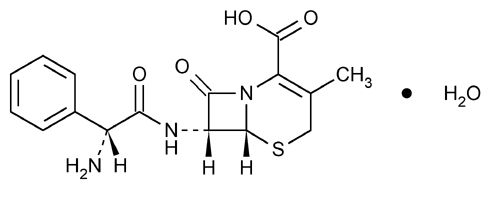
 365.41
5-Thia-1-azabicyclo[4.2.0]oct-2-ene-2-carboxylic acid, 7-[(aminophenylacetyl)amino]-3-methyl-8-oxo-, monohydrate, [6R-[6
 ,7
,7 (R*)]]-.
(6R,7R)-7-[(R)-2-Amino-2-phenylacetamido]-3-methyl-8-oxo-5-thia-1-azabicyclo[4.2.0]oct-2-ene-2-carboxylic acid monohydrate
[23325-78-2].Anhydrous 347.40
[15686-71-2].» Cephalexin has a potency of not less than 950 µg and not more than 1030 µg of C16H17N3O4S per mg, calculated on the anhydrous basis.
Packaging and storage—
Preserve in tight containers.
Identification—
A:
The IR absorption spectrum of a potassium bromide dispersion of it exhibits maxima only at the same wavelengths as that of a similar preparation of USP Cephalexin RS.
B:
The UV absorption spectrum of a solution (1 in 50,000) exhibits maxima and minima at the same wavelengths as that of a similar solution of USP Cephalexin RS, concomitantly measured, and the absorptivity, calculated on the anhydrous basis, at the wavelength of maximum absorbance at about 262 nm is not less than 95.0% and not more than 104.0% of that of USP Cephalexin RS, the potency of the Reference Standard being taken into account.
C:
Prepare a solution of it in water, with the aid of 0.1 N hydrochloric acid, containing 25 mg per mL (test solution). Separately apply 5 µL of the test solution and 5 µL of a Standard solution containing about 25 mg of USP Cephalexin RS per mL, prepared by dissolving it in water with the aid of 0.1 N hydrochloric acid, to a suitable thin-layer chromatographic plate (see Chromatography  621
621 ) coated with a 0.25-mm layer of chromatographic silica gel mixture. Allow the spots to dry, place the plate in a saturated chamber containing a solvent system consisting of a mixture of ethyl acetate, water, acetonitrile, and glacial acetic acid (42:18:14:14) and lined with filter paper. Develop the chromatogram until the solvent front has moved about three-fourths of the length of the plate. Remove the plate from the developing chamber, mark the solvent front, allow the plate to air-dry, and examine under short-wavelength UV light: the RF value of the principal spot obtained from the test solution corresponds to that obtained from the Standard solution.
621) coated with a 0.25-mm layer of chromatographic silica gel mixture. Allow the spots to dry, place the plate in a saturated chamber containing a solvent system consisting of a mixture of ethyl acetate, water, acetonitrile, and glacial acetic acid (42:18:14:14) and lined with filter paper. Develop the chromatogram until the solvent front has moved about three-fourths of the length of the plate. Remove the plate from the developing chamber, mark the solvent front, allow the plate to air-dry, and examine under short-wavelength UV light: the RF value of the principal spot obtained from the test solution corresponds to that obtained from the Standard solution.
Specific rotation 781S:
between +149 and +158.
781S:
between +149 and +158.
Test solution:
5 mg per mL, in pH 4.4 neutralized phthalate buffer (see Buffer Solutions in the section Reagents, Indicators, and Solutions).
Crystallinity 695:
meets the requirements.
695:
meets the requirements.
pH 791:
between 3.0 and 5.5, in an aqueous suspension containing 50 mg per mL.
791:
between 3.0 and 5.5, in an aqueous suspension containing 50 mg per mL.
Water, Method I 921:
between 4.0% and 8.0%.
921:
between 4.0% and 8.0%.
Related compounds—
Solution A—
Dissolve 1 g of sodium 1-pentanesulfonate in a mixture of 1000 mL of water and 15 mL of triethylamine. Adjust with phosphoric acid to a pH of 2.5 ± 0.1. Make adjustments if necessary (see System Suitability under Chromatography 621).
621).
Solution B—
Dissolve 1 g of sodium 1-pentanesulfonate in a mixture of 300 mL of water and 15 mL of triethylamine. Adjust with phosphoric acid to a pH of 2.5 ± 0.1, add 350 mL of acetonitrile and 350 mL of methanol, and mix. Make adjustments if necessary (see System Suitability under Chromatography 621).
621).
Mobile phase—
Use variable mixtures of Solution A and Solution B as directed for Chromatographic System.
Solvent—
Dissolve 18 g of monobasic potassium phosphate in 1000 mL of water.
Standard solutions—
Dissolve accurately weighed quantities of USP Cephalexin RS quantitatively in Solvent to obtain solutions having known concentrations of about 0.08 and 0.16 mg of cephalexin (C16H17N3O4S) per mL, respectively, taking into account the stated potency of the USP Cephalexin RS.
Test solution—
Transfer about 25 mg of Cephalexin, accurately weighed, to a 5-mL volumetric flask, dissolve in and dilute with Solvent to volume, and mix.
Chromatographic system
(see Chromatography 621)—The liquid chromatograph is equipped with a 254-nm detector and a 4.6-mm × 25-cm column that contains packing L1 of low acidity. The flow rate is about 1 mL per minute. The chromatograph is programmed as follows.
621)—The liquid chromatograph is equipped with a 254-nm detector and a 4.6-mm × 25-cm column that contains packing L1 of low acidity. The flow rate is about 1 mL per minute. The chromatograph is programmed as follows.
| Time (minutes) |
Solution A
(%) |
Solution B
(%) |
Elution |
| 0 | 100 | 0 | equilibration |
| 0–1 | 100 | 0 | isocratic |
| 1–33.3 | 100®0 | 0®100 | linear gradient |
| 33.3–34.3 | 0 | 100 | isocratic |
Procedure—
Separately inject equal volumes (about 20 µL) of the Standard solutions and the Test solution into the chromatograph, record the chromatograms, and measure the responses for the cephalexin peaks in the chromatograms obtained from the Standard solutions and for all of the peaks, other than that from cephalexin, in the chromatogram obtained from the Test solution. Plot the responses of the cephalexin peaks in the chromatograms obtained from the Standard solutions versus their concentrations, calculated on the anhydrous basis, in mg per mL, and draw a straight line through the two points and zero. From the line so obtained and the peak responses obtained from the Test solution, determine the concentration, I, in mg per mL, of each cephalexin-related substance obtained from the Test solution other than the cephalexin peak. Calculate the percentage of each cephalexin-related substance by the formula:
500I/W
in which W is the quantity, calculated on the anhydrous basis, in mg, of Cephalexin taken to prepare the Test solution: not more than 1.0% of any individual cephalexin-related substance is found; and the sum of all cephalexin-related substances found is not greater than 5.0%.
Dimethylaniline 223:
meets the requirement.
223:
meets the requirement.
Assay—
Mobile phase—
Prepare 1015 mL of a suitable mixture of water, acetonitrile, methanol, and triethylamine (850:100:50:15). Dissolve 1.0 g of sodium 1-pentanesulfonate in this mixture, adjust with phosphoric acid to a pH of 3.0 ± 0.1, and degas. Make adjustments if necessary (see System Suitability under Chromatography 621).
621).
Internal standard solution—
Transfer 300 mg of 1-hydroxybenzotriazole to a 1000-mL volumetric flask, dissolve in 10 mL of methanol, dilute with Mobile phase to volume, and mix.
Standard preparation—
Dissolve an accurately weighed quantity of USP Cephalexin RS quantitatively in water to obtain a stock solution having a known concentration of about 1 mg per mL. Transfer 10.0 mL of this stock solution to a 50-mL, glass-stoppered flask, add 15.0 mL of Internal standard solution, and mix.
Assay preparation—
Transfer about 100 mg of Cephalexin, accurately weighed, to a 100-mL volumetric flask, dissolve in and dilute with water to volume, and mix. Transfer 10.0 mL of this solution to a 50-mL, glass-stoppered flask, add 15.0 mL of Internal standard solution, and mix.
Chromatographic system
(see Chromatography 621)—The liquid chromatograph is equipped with a 254-nm detector and a 4.6-mm × 25-cm column that contains packing L1 of low acidity. The flow rate is about 1.5 mL per minute. Chromatograph the Standard preparation, and record the peak responses as directed under Procedure: the resolution, R, between the internal standard and the analyte peaks is not less than 5; and the relative standard deviation for replicate injections is not more than 2.0%.
621)—The liquid chromatograph is equipped with a 254-nm detector and a 4.6-mm × 25-cm column that contains packing L1 of low acidity. The flow rate is about 1.5 mL per minute. Chromatograph the Standard preparation, and record the peak responses as directed under Procedure: the resolution, R, between the internal standard and the analyte peaks is not less than 5; and the relative standard deviation for replicate injections is not more than 2.0%.
Procedure—
Separately inject equal volumes (about 20 µL) of the Standard preparation and the Assay preparation into the chromatograph, record the chromatograms, and measure the responses for the major peaks. The relative retention times are about 0.35 for 1-hydroxybenzotriazole and 1.0 for cephalexin. Calculate the quantity, in µg, of C16H17N3O4S per mg of the Cephalexin taken by the formula:
100(CP/M)(RU / RS)
in which C is the concentration, in mg per mL, of USP Cephalexin RS in the stock solution used to prepare the Standard preparation; P is the stated cephalexin content, in µg per mg, of USP Cephalexin RS; M is the quantity, in mg, of Cephalexin taken to prepare the Assay preparation; and RU and RS are the ratios of the responses of the cephalexin peak to the 1-hydroxybenzotriazole peak obtained from the Assay preparation and the Standard preparation, respectively.
Auxiliary Information—
Please check for your question in the FAQs before contacting USP.
Chromatographic Column—
| Topic/Question | Contact | Expert Committee |
| Monograph | Ahalya Wise, M.S.
Scientist 1-301-816-8161 |
(MDANT05) Monograph Development-Antibiotics |
| Reference Standards | Lili Wang, Technical Services Scientist 1-301-816-8129 RSTech@usp.org |
USP32–NF27 Page 1870
Chromatographic columns text is not derived from, and not part of, USP 32 or NF 27.