Calcium Citrate
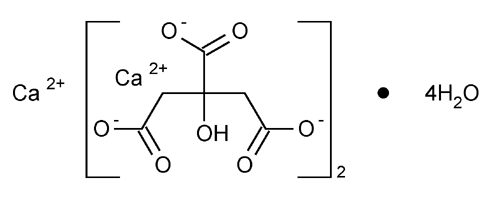

 570.49
1,2,3-Propanetricarboxylic acid, 2-hydroxy-, calcium salt (2:3), tetrahydrate.
Calcium citrate (3:2), tetrahydrate
[5785-44-4].» Calcium Citrate contains four molecules of water of hydration. When dried at 150 to constant weight, it contains not less than 97.5 percent and not more than 100.5 percent of Ca3(C6H5O7)2.
to constant weight, it contains not less than 97.5 percent and not more than 100.5 percent of Ca3(C6H5O7)2.
Packaging and storage—
Preserve in well-closed containers.
Identification—
A:
Dissolve 0.5 g in a mixture of 10 mL of water and 2.5 mL of 2 N nitric acid. Add 1 mL of mercuric sulfate TS, heat to boiling, and add 1 mL of potassium permanganate TS: a white precipitate is formed.
B:
Ignite completely 0.5 g at as low a temperature as possible, cool, and dissolve the residue in a mixture of 10 mL of water and 1 mL of glacial acetic acid. Filter, and add 10 mL of ammonium oxalate TS to the filtrate: a voluminous white precipitate is formed, and it is soluble in hydrochloric acid.
Loss on drying  731
731 —
Dry it at 150 for 4 hours: it loses between 10.0% and 13.3% of its weight.
—
Dry it at 150 for 4 hours: it loses between 10.0% and 13.3% of its weight.
731—
Dry it at 150 for 4 hours: it loses between 10.0% and 13.3% of its weight.
Arsenic, Method I 211—
Dissolve 1 g in 5 mL of 3 N hydrochloric acid, and dilute with water to 35 mL: the limit is 3 µg per g.
211—
Dissolve 1 g in 5 mL of 3 N hydrochloric acid, and dilute with water to 35 mL: the limit is 3 µg per g.
Limit of fluoride—
[note—Prepare and store all solutions in plastic containers.]
Standard solution—
Dissolve an accurately weighed quantity of USP Sodium Fluoride RS quantitatively in water to obtain a solution containing 2.210 mg per mL. On the day of use, transfer 5.0 mL of this solution to a 1000-mL volumetric flask, dilute with water to volume, and mix. Each mL of this solution contains 5 µg of fluoride ion.
Electrode system—
Use a fluoride-specific, ion-indicating electrode and a silver–silver chloride reference electrode connected to a pH meter capable of measuring potentials with a minimum reproducibility of ±0.2 mV (see pH 791).
791).
Standard response line—
Transfer 1.0, 5.0, and 10.0 mL of the Standard solution to separate 250-mL plastic beakers, to each add 50 mL of water, 5 mL of 1 N hydrochloric acid, 10 mL of 1.0 M sodium citrate, and 10 mL of 0.2 M edetate disodium, and mix. If necessary, adjust with 1 N sodium hydroxide or 1 N hydrochloric acid to a pH of 5.5. Transfer each solution to a separate 100-mL volumetric flask, dilute with water to volume, and mix. Transfer 50 mL of each solution to separate 250-mL plastic beakers, and measure the potential of each solution with the Electrode system. Between each reading wash the electrodes with water, and absorb any residual water by blotting the electrodes dry. Plot the logarithms of the fluoride concentrations (0.05, 0.25, and 0.50 µg per mL, respectively) versus potential, in mV.
Procedure—
Transfer 1.0 g of Calcium Citrate to a 100-mL beaker, add 10 mL of water and, while stirring, 10 mL of 1 N hydrochloric acid. When dissolved, boil rapidly for 1 minute, transfer the solution to a 250-mL plastic beaker, and cool in ice water. Add 15 mL of 1.0 M sodium citrate and 10 mL of 0.2 M edetate disodium, and adjust with 1 N sodium hydroxide or 1 N hydrochloric acid to a pH of 5.5. Transfer this solution to a 100-mL volumetric flask, dilute with water to volume, and mix. Transfer 50 mL of this solution to a 250-mL plastic beaker, and measure the potential of this test solution with the Electrode system. From the measured potential and the Standard response line determine the concentration, C, in µg per mL, of fluoride ion in the test solution. Calculate the percentage of fluoride in the specimen taken by multiplying C by 0.01: the limit is 0.003%.
Limit of acid-insoluble substances—
Dissolve 5 g by heating with a mixture of 10 mL of hydrochloric acid and 50 mL of water for 30 minutes: the residue so obtained, filtered, washed, and dried at 105 for 2 hours, weighs not more than 10 mg (0.2%).
for 2 hours, weighs not more than 10 mg (0.2%).
Lead 251—
Prepare a Test Preparation by dissolving 0.5 g in 20 mL of 3 N hydrochloric acid, evaporating on a steam bath to about 10 mL, diluting with water to about 20 mL, and cooling. Use 5 mL of Diluted Standard Lead Solution (5 µg of Pb) for the test: the limit is 0.001%.
251—
Prepare a Test Preparation by dissolving 0.5 g in 20 mL of 3 N hydrochloric acid, evaporating on a steam bath to about 10 mL, diluting with water to about 20 mL, and cooling. Use 5 mL of Diluted Standard Lead Solution (5 µg of Pb) for the test: the limit is 0.001%.
Heavy metals, Method I 231—
Dissolve 1 g in a mixture of 20 mL of water and 2 mL of hydrochloric acid, add 1.5 mL of ammonium hydroxide, and dilute with water to 25 mL: the limit is 0.002%.
231—
Dissolve 1 g in a mixture of 20 mL of water and 2 mL of hydrochloric acid, add 1.5 mL of ammonium hydroxide, and dilute with water to 25 mL: the limit is 0.002%.
Assay—
Dissolve about 350 mg of Calcium Citrate, previously dried at 150 to constant weight and accurately weighed, in a mixture of 10 mL of water and 2 mL of 3 N hydrochloric acid, and dilute with water to about 100 mL. While stirring, add about 30 mL of 0.05 M edetate disodium VS from a 50-mL buret. Add 15 mL of 1 N sodium hydroxide and 300 mg of hydroxy naphthol blue, and continue the titration to a blue endpoint. Each mL of 0.05 M edetate disodium is equivalent to 8.307 mg of Ca3(C6H5O7)2.
to constant weight and accurately weighed, in a mixture of 10 mL of water and 2 mL of 3 N hydrochloric acid, and dilute with water to about 100 mL. While stirring, add about 30 mL of 0.05 M edetate disodium VS from a 50-mL buret. Add 15 mL of 1 N sodium hydroxide and 300 mg of hydroxy naphthol blue, and continue the titration to a blue endpoint. Each mL of 0.05 M edetate disodium is equivalent to 8.307 mg of Ca3(C6H5O7)2.
Auxiliary Information—
Please check for your question in the FAQs before contacting USP.
Chromatographic Column—
| Topic/Question | Contact | Expert Committee |
| Monograph | Daniel K. Bempong, Ph.D.
Senior Scientist 1-301-816-8143 |
(MDPS05) Monograph Development-Pulmonary and Steroids |
| Reference Standards | Lili Wang, Technical Services Scientist 1-301-816-8129 RSTech@usp.org |
USP32–NF27 Page 1762
Pharmacopeial Forum: Volume No. 27(6) Page 3257
Chromatographic columns text is not derived from, and not part of, USP 32 or NF 27.