Caffeine
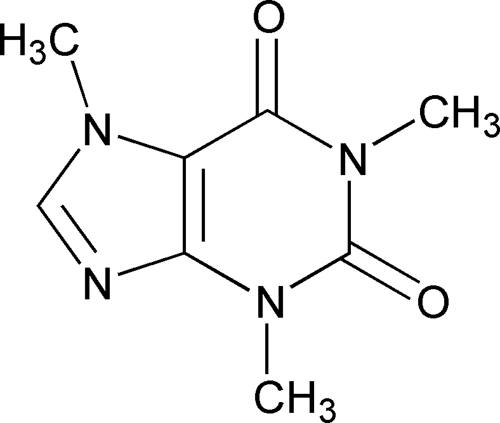
 194.19
1H-Purine-2,6-dione, 3,7-dihydro-1,3,7-trimethyl-.
1,3,7-Trimethylxanthine
[58-08-2].Monohydrate 212.21
[5743-12-4].» Caffeine is anhydrous or contains one molecule of water of hydration. It contains not less than 98.5 percent and not more than 101.0 percent of C8H10N4O2, calculated on the anhydrous basis.
Packaging and storage—
Preserve hydrous Caffeine in tight containers. Preserve anhydrous Caffeine in well-closed containers.
Labeling—
Label it to indicate whether it is anhydrous or hydrous.
Identification—
B:
Dissolve about 5 mg in 1 mL of hydrochloric acid in a porcelain dish, add 50 mg of potassium chlorate, and evaporate on a steam bath to dryness. Invert the dish over a vessel containing a few drops of 6 N ammonium hydroxide: the residue acquires a purple color, which disappears upon the addition of a solution of 1 N sodium hydroxide.
Water, Method III  921
921 —
Dry it at 80
—
Dry it at 80 for 4 hours: the anhydrous form loses not more than 0.5% and the hydrous form not more than 8.5% of its weight.
921—
Dry it at 80 for 4 hours: the anhydrous form loses not more than 0.5% and the hydrous form not more than 8.5% of its weight.
Residue on ignition 281:
not more than 0.1%.
281:
not more than 0.1%.
Heavy metals, Method II 231:
0.001%.
231:
0.001%.
Readily carbonizable substances 271—
Dissolve 0.5 g in 5 mL of sulfuric acid TS: the solution has no more color than Matching Fluid D.
271—
Dissolve 0.5 g in 5 mL of sulfuric acid TS: the solution has no more color than Matching Fluid D.
Other alkaloids—
To 5 mL of a solution (1 in 50) add mercuric-potassium iodide TS: no precipitate is formed.
Chromatographic purity—
Mobile phase, System suitability preparation, Standard preparation, and Chromatographic system—
Proceed as directed in the Assay.
Test preparation—
Use the Assay preparation.
Procedure—
Inject a volume (about 10 µL) of the Test preparation into the chromatograph, record the chromatogram, and measure all the peak responses. Calculate the percentage of each impurity in the portion of Caffeine taken by the formula:
100(ri / rs)
in which ri is the peak response for each impurity, and rs is the sum of the responses of all the peaks: not more than 0.1% of any individual impurity is found; and not more than 0.1% of total impurities is found.
Assay—
Mobile phase—
Transfer about 1.64 g of anhydrous sodium acetate, accurately weighed, to a 2-L volumetric flask, dissolve in and dilute with water to volume, and mix. Transfer 1910 mL of this solution to another 2-L volumetric flask, add 50 mL of acetonitrile and 40 mL of tetrahydrofuran, and mix. Adjust with glacial acetic acid to a pH of 4.5, mix, filter, and degas.
System suitability preparation—
Transfer about 2 mg of theophylline, accurately weighed, to a 100-mL volumetric flask, add about 50 mL of Mobile phase, shake, and sonicate, if necessary, to dissolve. Dilute with Mobile phase to volume, and mix.
Standard preparation—
Transfer an acccurately weighed quantity of about 5.0 mg of USP Caffeine RS to a 25-mL volumetric flask, add 5.0 mL of System suitability preparation and 10 mL of Mobile phase, shake, and sonicate, if necessary, to dissolve. Dilute with Mobile phase to volume, mix, and filter.
Assay preparation—
Transfer about 10 mg of Caffeine, accurately weighed, to a 50-mL volumetric flask, add 10 mL of Mobile phase, shake, and sonicate, if necessary, to dissolve. Dilute with Mobile phase to volume, mix, and filter.
Chromatographic system (see Chromatography 621)—
The liquid chromatograph is equipped with a 275-nm detector and a 4.6-mm × 15-cm column containing packing L1. The flow rate is about 1 mL per minute. Chromatograph the Standard preparation, and record the peak responses as directed for Procedure: the relative retention times for theophylline and caffeine are about 0.69 and 1.0, respectively; the resolution, R, between theophylline and caffeine is not less than 6.0; the tailing factor for each of the peaks identified in the chromatogram is not more than 2.0; and the relative standard deviation is not more than 2.0%.
621)—
The liquid chromatograph is equipped with a 275-nm detector and a 4.6-mm × 15-cm column containing packing L1. The flow rate is about 1 mL per minute. Chromatograph the Standard preparation, and record the peak responses as directed for Procedure: the relative retention times for theophylline and caffeine are about 0.69 and 1.0, respectively; the resolution, R, between theophylline and caffeine is not less than 6.0; the tailing factor for each of the peaks identified in the chromatogram is not more than 2.0; and the relative standard deviation is not more than 2.0%.
Procedure—
Separately inject equal volumes (about 10 µL) of the Standard preparation and the Assay preparation into the chromatograph, record the chromatograms, and measure the responses for the caffeine peaks. Calculate the quantity, in mg, of C8H10N4O2 in the portion of Caffeine taken by the formula:
50C(rU / rS)
in which C is the concentration, in mg per mL, of USP Caffeine RS in the Standard preparation; and rU and rS are the peak responses for caffeine obtained from the Assay preparation and the Standard preparation, respectively.
Auxiliary Information—
Please check for your question in the FAQs before contacting USP.
Chromatographic Column—
| Topic/Question | Contact | Expert Committee |
| Monograph | Ravi Ravichandran, Ph.D.
Senior Scientist 1-301-816-8330 |
(MDPP05) Monograph Development-Psychiatrics and Psychoactives |
| Reference Standards | Lili Wang, Technical Services Scientist 1-301-816-8129 RSTech@usp.org |
USP32–NF27 Page 1741
Pharmacopeial Forum: Volume No. 34(5) Page 1150
Chromatographic columns text is not derived from, and not part of, USP 32 or NF 27.