Potassium Alginate
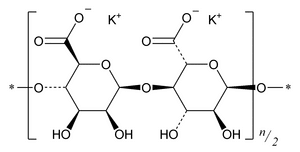
Alginic acid, potassium salt;
Potassium alginate [9005-36-1].
(poe tas' ee um al' ji nate).
+'&img=../../images/v35300/cas-9005-36-1.gif&casNumber=9005-36-1&usp=35&nf=30&chemicalStructureImage=true&ID='+parent.myID,600,500);)
Alginic acid, potassium salt;
Potassium alginate
[9005-36-1].DEFINITION
Potassium Alginate is the purified carbohydrate product extracted from various species of brown seaweeds by the use of dilute alkali. It consists chiefly of the potassium salt of Alginic Acid, a linear glycuronoglycan consisting of  -1,4-linked d-mannuronic acid and l-guluronic acid units in the pyranose ring form. It yields NLT 16.5% and NMT 19.5% of carbon dioxide (CO2), equivalent to NLT 89.2% and NMT 105.5% of potassium alginate, calculated on the dried basis.
-1,4-linked d-mannuronic acid and l-guluronic acid units in the pyranose ring form. It yields NLT 16.5% and NMT 19.5% of carbon dioxide (CO2), equivalent to NLT 89.2% and NMT 105.5% of potassium alginate, calculated on the dried basis.IDENTIFICATION
• A.
Analysis:
To 5 mL of a 1-in-100 solution in 0.1 N sodium hydroxide add 1 mL of calcium chloride TS.
Acceptance criteria:
A voluminous, gelatinous precipitate is formed.
• B.
Analysis:
To 10 mL of a 1-in-100 solution in 0.1 N sodium hydroxide add 1 mL of 2 N sulfuric acid.
Acceptance criteria:
A heavy, gelatinous precipitate is formed.
• C.
Analysis:
To 5 mg in a test tube add 5 mL of water, 1 mL of a freshly prepared 1-in-100 solution of 1,3-naphthalenediol in alcohol, and 5 mL of hydrochloric acid. Heat the mixture to boiling, boil gently for 3 min, then cool to 15 . Transfer the contents of the test tube to a 30-mL separator with the aid of 5 mL of water, and extract with 15 mL of isopropyl ether.
. Transfer the contents of the test tube to a 30-mL separator with the aid of 5 mL of water, and extract with 15 mL of isopropyl ether.
Acceptance criteria:
The isopropyl ether extract exhibits a deeper purplish hue than that from a blank, similarly prepared.
• D. Identification Tests—General, Potassium  191
191
191
Analysis:
Ignite completely 0.2 g at as low a temperature as possible.
Acceptance criteria:
A solution of the residue meets the requirements of the tests.
ASSAY
• Alginates Assay 311:
16.5%–19.5% of CO2, equivalent to 89.2%–105.5% of potassium alginate on the dried basis
311:
16.5%–19.5% of CO2, equivalent to 89.2%–105.5% of potassium alginate on the dried basis
IMPURITIES
• Arsenic, Method II 211:
NMT 1.5 ppm
211:
NMT 1.5 ppm
• Lead 251
251
Standard solution:
5 mL of Diluted standard lead solution
Test Preparation:
Add 1.0 g to 20 mL of nitric acid in a 250-mL conical flask, mix, and heat carefully until the Potassium Alginate is dissolved. Continue the heating until the volume is reduced to 7 mL. Cool rapidly to room temperature, transfer to a 100-mL volumetric flask, and dilute with water to volume. Use a 50-mL sample of the Test Preparation.
Analysis:
Proceed as directed in the chapter using 15 mL of ammonium citrate solution, 3 mL of potassium cyanide solution, and 0.5 mL of hydroxylamine hydrochloride solution being used for the test. After the first dithizone extractions, wash the combined chloroform layers with 5 mL of water, discarding the water layer and continuing in the usual manner by extracting with 20 mL of 0.2 N nitric acid.
Acceptance criteria:
50.0 mL portion of the Test preparation contains NMT 5 µg of lead (corresponding to NMT 10 ppm of lead)
• Heavy Metals, Method II 231
231
Analysis:
Conduct the ignition in a platinum crucible, and use nitric acid in place of sulfuric acid to wet the sample.
Acceptance criteria:
NMT 40 ppm
SPECIFIC TESTS
• Articles of Botanical Origin, Total Ash 561
561
Analysis:
Proceed as directed for Total Ash under Methods of Analysis, carefully igniting 3 g in a tared platinum dish, until the residue is thoroughly carbonized (5 min), and then igniting in a muffle furnace at a temperature of 800 ± 25 until the carbon is completely burned off (approximately 75 min).
until the carbon is completely burned off (approximately 75 min).
Acceptance criteria:
24.0%–32.0% of ash is found, calculated on the as-is basis.
• Microbial Enumeration Tests 61 and Tests for Specified Microorganisms 62:
The total aerobic microbial count does not exceed 103 cfu/g, and the total combined molds and yeasts count does not exceed 102 cfu/g.
61 and Tests for Specified Microorganisms 62:
The total aerobic microbial count does not exceed 103 cfu/g, and the total combined molds and yeasts count does not exceed 102 cfu/g.
• Loss on Drying 731:
Dry a sample at 105 for 4 h: it loses NMT 15% of its weight.
731:
Dry a sample at 105 for 4 h: it loses NMT 15% of its weight.
ADDITIONAL REQUIREMENTS
• Packaging and Storage:
Preserve in well-closed containers. No storage requirements specified.
Auxiliary Information—
Please check for your question in the FAQs before contacting USP.
| Topic/Question | Contact | Expert Committee |
|---|---|---|
| Monograph | Robert H. Lafaver, M.S.
Scientific Liaison 1-301-816-8335 |
(EXC2010) Monographs - Excipients |
| 61 |
Radhakrishna S Tirumalai, Ph.D.
Principal Scientific Liaison 1-301-816-8339 |
(GCM2010) General Chapters - Microbiology |
| 62 |
Radhakrishna S Tirumalai, Ph.D.
Principal Scientific Liaison 1-301-816-8339 |
(GCM2010) General Chapters - Microbiology |
USP35–NF30 Page 1926
Pharmacopeial Forum: Volume No. 31(5) Page 1426