Ferrous Fumarate
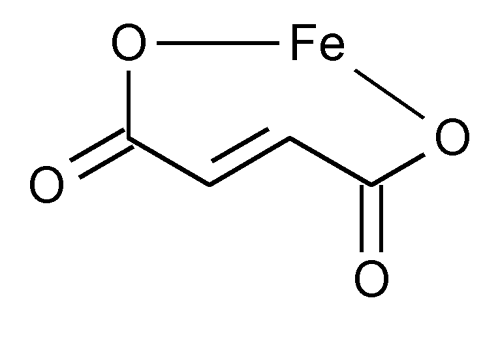
 169.90
2-Butenedioic acid, (E)-, iron(2+) salt.
Iron(2+) fumarate
[141-01-5].» Ferrous Fumarate contains not less than 97.0 percent and not more than 101.0 percent of C4H2FeO4, calculated on the dried basis.
Packaging and storage—
Preserve in well-closed containers.
Identification—
A:
To 1.5 g add 25 mL of dilute hydrochloric acid (1 in 2). Dilute with water to 50 mL, heat to dissolve, then cool, filter on a fine-porosity, sintered-glass crucible, wash the precipitate with dilute hydrochloric acid (3 in 100), saving the filtrate for Identification test B, and dry the precipitate at 105 : the IR absorption of a potassium bromide dispersion of the dried precipitate so obtained exhibits maxima only at the same wavelengths as that of a similar preparation of USP Fumaric Acid RS.
: the IR absorption of a potassium bromide dispersion of the dried precipitate so obtained exhibits maxima only at the same wavelengths as that of a similar preparation of USP Fumaric Acid RS.
B:
A portion of the filtrate obtained in the preceding test responds to the tests for Iron  191
191 .
.
191.
Loss on drying 731—
Dry it at 105 for 16 hours: it loses not more than 1.5% of its weight.
731—
Dry it at 105 for 16 hours: it loses not more than 1.5% of its weight.
Sulfate—
Transfer 1.0 g to a 250-mL beaker, add 100 mL of water, and heat on a steam bath, adding hydrochloric acid dropwise, until complete solution is effected (about 2 mL of the acid will be required). Filter the solution if necessary, and dilute the filtrate with water to 100 mL. Heat the filtrate to boiling, add 10 mL of barium chloride TS, warm on a steam bath for 2 hours, cover, and allow to stand for 16 hours. (If crystals of ferrous fumarate form, warm the solution on the steam bath to dissolve them.) Pass the solution through ashless filter paper, wash the residue with hot water until, with the addition of ammonium sulfide TS, a black precipitate is no longer formed in the filtrate, and transfer the paper containing the residue to a tared crucible. Char the paper, without burning, and ignite the crucible and its contents at 600 to constant weight: each mg of residue is equivalent to 0.412 mg of SO4. Not more than 0.2% is found.
to constant weight: each mg of residue is equivalent to 0.412 mg of SO4. Not more than 0.2% is found.
Arsenic, Method I 211—
Transfer 2.0 g to a beaker, and add 10 mL of water and 10 mL of sulfuric acid. Warm to precipitate the fumaric acid completely, cool, add 30 mL of water, and filter into a 100-mL volumetric flask. Wash the precipitate with water, adding the washings to the flask, add water to volume, and mix. Transfer 50.0 mL of this solution into the arsine generator flask, and dilute with water to 55 mL: the resulting solution meets the requirements of the test, the addition of 20 mL of 7 N sulfuric acid specified for Procedure being omitted. The limit is 3 ppm.
211—
Transfer 2.0 g to a beaker, and add 10 mL of water and 10 mL of sulfuric acid. Warm to precipitate the fumaric acid completely, cool, add 30 mL of water, and filter into a 100-mL volumetric flask. Wash the precipitate with water, adding the washings to the flask, add water to volume, and mix. Transfer 50.0 mL of this solution into the arsine generator flask, and dilute with water to 55 mL: the resulting solution meets the requirements of the test, the addition of 20 mL of 7 N sulfuric acid specified for Procedure being omitted. The limit is 3 ppm.
Limit of ferric iron—
Transfer 2.0 g, accurately weighed, to a glass-stoppered, 250-mL conical flask, add 25 mL of water and 4 mL of hydrochloric acid, and heat on a hot plate until solution is complete. Insert the stopper in the flask, and cool to room temperature. Add 3 g of potassium iodide, insert the stopper in the flask, swirl to mix, and allow to stand in the dark for 5 minutes. Remove the stopper, add 75 mL of water, and titrate with 0.1 N sodium thiosulfate VS, adding 3 mL of starch TS as the end-point is approached. Not more than 7.16 mL of 0.1 N sodium thiosulfate is consumed (2.0%).
Limit of lead—
[note—For the preparation of all aqueous solutions and for the rinsing of glassware before use, employ water that has been passed through a strong-acid, strong-base, mixed-bed ion-exchange resin before use. Select all reagents to have as low a content of lead as practicable, and store all reagent solutions in containers of borosilicate glass. Clean glassware before use by soaking in warm 8 N nitric acid for 30 minutes and by rinsing with deionized water.]
Ascorbic acid–sodium iodide solution—
Dissolve 20 g of ascorbic acid and 38.5 g of sodium iodide in water in a 200-mL volumetric flask, dilute with water to volume, and mix.
Trioctylphosphine oxide solution—
[Caution—This solution causes irritation. Avoid contact with eyes, skin, and clothing. Take special precautions in disposing of unused portions of solutions to which this reagent is added.
] Dissolve 5.0 g of trioctylphosphine oxide in 4-methyl-2-pentanone in a 100-mL volumetric flask, dilute with the same solvent to volume, and mix.
Standard solution and Blank—
Transfer 5.0 mL of Lead Nitrate Stock Solution, prepared as directed in the test for Heavy Metals 231, to a 100-mL volumetric flask, dilute with water to volume, and mix. Transfer 2.0 mL of the resulting solution to a 50-mL beaker. To this beaker and to a second, empty beaker (Blank) add 6 mL of nitric acid and 10 mL of perchloric acid, and evaporate in a hood to dryness. [Caution—Use perchloric acid in a well-ventilated fume hood with proper precautions.
] Cool, dissolve the residues in 10 mL of 9 N hydrochloric acid, and transfer with the aid of about 10 mL of water to separate 50-mL volumetric flasks. To each flask add 20 mL of Ascorbic acid–sodium iodide solution and 5.0 mL of Trioctylphosphine oxide solution, shake for 30 seconds, and allow to separate. Add water to bring the organic solvent layer into the neck of each flask, shake again, and allow to separate. The organic solvent layers are the Blank and the Standard solution, and they contain 0.0 and 2.0 µg of lead per mL, respectively.
231, to a 100-mL volumetric flask, dilute with water to volume, and mix. Transfer 2.0 mL of the resulting solution to a 50-mL beaker. To this beaker and to a second, empty beaker (Blank) add 6 mL of nitric acid and 10 mL of perchloric acid, and evaporate in a hood to dryness. [Caution—Use perchloric acid in a well-ventilated fume hood with proper precautions.
] Cool, dissolve the residues in 10 mL of 9 N hydrochloric acid, and transfer with the aid of about 10 mL of water to separate 50-mL volumetric flasks. To each flask add 20 mL of Ascorbic acid–sodium iodide solution and 5.0 mL of Trioctylphosphine oxide solution, shake for 30 seconds, and allow to separate. Add water to bring the organic solvent layer into the neck of each flask, shake again, and allow to separate. The organic solvent layers are the Blank and the Standard solution, and they contain 0.0 and 2.0 µg of lead per mL, respectively.
Test solution—
Add 1.0 g of Ferrous Fumarate to a 50-mL beaker, and add 6 mL of nitric acid and 10 mL of perchloric acid. [Caution—Use perchloric acid in a well-ventilated fume hood with proper precautions.
] Cover with a ribbed watch glass, and heat in a hood until completely dry. Cool, dissolve the residue in 10 mL of 9 N hydrochloric acid, and transfer with the aid of about 10 mL of water to a 50-mL volumetric flask. Add 20 mL of Ascorbic acid–sodium iodide solution and 5.0 mL of Trioctylphosphine oxide solution, shake for 30 seconds, and allow to separate. Add water to bring the organic solvent layer into the neck of the flask, shake again, and allow to separate. The organic solvent layer is the Test solution.
Procedure—
Concomitantly determine the absorbances of the Blank, Standard solution, and Test solution at the lead emission line at 283.3 nm with a suitable atomic absorption spectrophotometer (see Spectrophotometry and Light-scattering 851) equipped with a lead hollow-cathode lamp and an air–acetylene flame, using the blank to set the instrument to zero. In a suitable analysis, the absorbance of the Standard solution and the absorbance of the Blank are significantly different: the absorbance of the Test solution does not exceed that of the Standard solution (0.001%).
851) equipped with a lead hollow-cathode lamp and an air–acetylene flame, using the blank to set the instrument to zero. In a suitable analysis, the absorbance of the Standard solution and the absorbance of the Blank are significantly different: the absorbance of the Test solution does not exceed that of the Standard solution (0.001%).
Mercury—
[notes—(1) Carry out this procedure in subdued light, since mercuric dithizonate is light-sensitive. (2) For preparation of solutions, see Mercury 261.] Dissolve about 1 g, accurately weighed, in 30 mL of dilute nitric acid (1 in 10), with the aid of heat, on a steam bath. Cool quickly by immersion in an ice bath, and pass through a fine-porosity filter that previously has been washed with dilute nitric acid (1 in 10) and water. To the filtrate add 20 mL of sodium citrate solution (1 in 4) and 1 mL of Hydroxylamine Hydrochloride Solution.
261.] Dissolve about 1 g, accurately weighed, in 30 mL of dilute nitric acid (1 in 10), with the aid of heat, on a steam bath. Cool quickly by immersion in an ice bath, and pass through a fine-porosity filter that previously has been washed with dilute nitric acid (1 in 10) and water. To the filtrate add 20 mL of sodium citrate solution (1 in 4) and 1 mL of Hydroxylamine Hydrochloride Solution.
Prepare a control solution consisting of 3.0 mL of Standard Mercury Solution, 30 mL of dilute nitric acid (1 in 10), 5 mL of sodium citrate solution (1 in 4), and 1 mL of Hydroxylamine Hydrochloride Solution.
Using ammonium hydroxide, adjust the control solution to a pH of 1.8, determined potentiometrically, and transfer to a separator. Using sulfuric acid, adjust the test solution to a pH of 1.8, determined potentiometrically, and transfer to a separator. Treat the solution under test and the control solution in parallel as follows. Extract with two 5-mL portions of Dithizone Extraction Solution and 5 mL of chloroform, pooling the chloroform extracts in a second separator. Add 10 mL of dilute hydrochloric acid (1 in 2), shake, allow the layers to separate, and discard the chloroform layer. Wash the acid extract with 3 mL of chloroform, and discard the washing. Add 0.1 mL of edetate disodium solution (1 in 50) and 2 mL of 6 N acetic acid, mix, and add slowly 5 mL of ammonium hydroxide. Close the separator, cool it under cold running water, and dry its outer surface. Remove the stopper, and pour the contents into a beaker. Adjust the solution under test and the control solution to a pH of 1.8 in the same manner as before, and return the solutions to their respective separators. Add 5.0 mL of Diluted Dithizone Extraction Solution, shake vigorously, and allow the layers to separate. Using Diluted Dithizone Extraction Solution as a color blank, compare the colors developed in the chloroform layers of the solution under test and the control solution: the color developed by the solution under test is not more intense than that developed by the control solution (3 µg per g).
Assay—
Transfer 500 mg of Ferrous Fumarate, accurately weighed, to a 500-mL conical flask, and add 25 mL of dilute hydrochloric acid (2 in 5). Heat to boiling, and add a solution of 5.6 g of stannous chloride in 50 mL of dilute hydrochloric acid (3 in 10) dropwise until the yellow color disappears, then add 2 drops in excess. Cool the solution in an ice bath to room temperature, add 10 mL of mercuric chloride solution (1 in 20), and allow to stand for 5 minutes. Add 200 mL of water, 25 mL of dilute sulfuric acid (1 in 2), and 4 mL of phosphoric acid, then add 2 drops of orthophenanthroline TS, and titrate with 0.1 N ceric sulfate VS. Perform a blank determination, and make any necessary correction. Each mL of 0.1 N ceric sulfate is equivalent to 16.99 mg of C4H2FeO4.
Auxiliary Information—
Please check for your question in the FAQs before contacting USP.
Chromatographic Column—
| Topic/Question | Contact | Expert Committee |
| Monograph | Curtis Phinney
1-301-816-8540 |
(DSN05) Dietary Supplements - Non-Botanicals |
| Reference Standards | Lili Wang, Technical Services Scientist 1-301-816-8129 RSTech@usp.org |
USP32–NF27 Page 2360
Pharmacopeial Forum: Volume No. 29(3) Page 629
Chromatographic columns text is not derived from, and not part of, USP 32 or NF 27.