Diatrizoic Acid
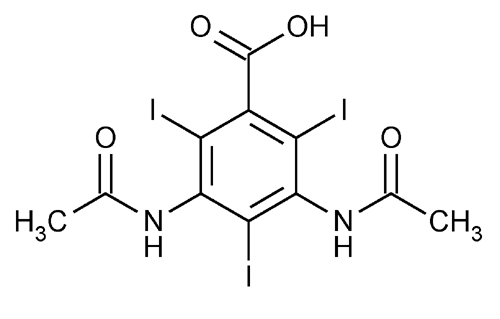
 613.91
Benzoic acid, 3,5-bis(acetylamino)-2,4,6-triiodo-.
3,5-Diacetamido-2,4,6-triiodobenzoic acid
[117-96-4].Dihydrate 649.95
[50978-11-5].» Diatrizoic Acid is anhydrous or contains two molecules of water of hydration. It contains not less than 98.0 percent and not more than 102.0 percent of C11H9I3N2O4, calculated on the anhydrous basis.
Packaging and storage—
Preserve in well-closed containers. Store at room temperature.
Labeling—
Label it to indicate whether it is anhydrous or hydrous.
Identification—
A:
It responds to the Thin-Layer Chromatographic Identification Test  201
201 , the test solution and the Standard solution being prepared at a concentration of 1 mg per mL in a 0.8 in 1000 solution of sodium hydroxide in methanol, the solvent mixture being a mixture of chloroform, methanol, and ammonium hydroxide (20:10:2), and short-wavelength UV light being used to locate the spots.
201, the test solution and the Standard solution being prepared at a concentration of 1 mg per mL in a 0.8 in 1000 solution of sodium hydroxide in methanol, the solvent mixture being a mixture of chloroform, methanol, and ammonium hydroxide (20:10:2), and short-wavelength UV light being used to locate the spots.
B:
Heat about 500 mg in a suitable crucible: violet vapors are evolved.
Water, Method I 921:
not more than 1.0% (anhydrous form), and between 4.5% and 7.0% (hydrous form).
921:
not more than 1.0% (anhydrous form), and between 4.5% and 7.0% (hydrous form).
Residue on ignition 281:
not more than 0.1%.
281:
not more than 0.1%.
Iodine and iodide—
Test preparation—
Suspend 10.0 g in 10 mL of water, and add in small portions, with stirring, 1.5 mL of sodium hydroxide solution (2 in 5). When solution is complete, adjust to a pH between 7.0 and 7.5 with a dilute solution (1 in 125) of sodium hydroxide or hydrochloric acid, and dilute with water to 20 mL.
Procedure—
Dilute 4.0 mL of Test preparation with 20 mL of water in a 50-mL centrifuge tube provided with a stopper, and proceed as directed for Procedure under Diatrizoate Meglumine.
Heavy metals 231—
To a 50-mL color-comparison tube transfer 2.0 mL of solution prepared as directed for Test preparation in the test for Iodine and iodide, add 5 mL of 1 N sodium hydroxide, dilute with water to 40 mL, and mix. Using this as the Test preparation, proceed as directed in the test for Heavy metals under Diatrizoate Meglumine: the limit is 0.002%.
231—
To a 50-mL color-comparison tube transfer 2.0 mL of solution prepared as directed for Test preparation in the test for Iodine and iodide, add 5 mL of 1 N sodium hydroxide, dilute with water to 40 mL, and mix. Using this as the Test preparation, proceed as directed in the test for Heavy metals under Diatrizoate Meglumine: the limit is 0.002%.
Free aromatic amine—
Transfer 1.0 g to a 50-mL volumetric flask, and add 12.5 mL of water and 2.5 mL of 1 N sodium hydroxide. Proceed as directed in the test for Free aromatic amine under Diatrizoate Meglumine, beginning with “To a second 50-mL volumetric flask transfer 4 mL of water.” The absorbance of the solution from the Diatrizoic Acid is not greater than that of the Standard solution (0.05%).
Assay—
Transfer about 300 mg of Diatrizoic Acid, accurately weighed, to a glass-stoppered, 125-mL conical flask, and proceed as directed in the Assay under Diatrizoate Meglumine, beginning with “add 30 mL of 1.25 N sodium hydroxide.” Each mL of 0.05 N silver nitrate is equivalent to 10.23 mg of C11H9I3N2O4.
Auxiliary Information—
Please check for your question in the FAQs before contacting USP.
| Topic/Question | Contact | Expert Committee |
| Monograph | Ian DeVeau, Ph.D.
Director, Veterinary Drugs and Radiopharmaceuticals 1-301-816-8178 |
(RMI05) Radiopharmaceuticals and Medical Imaging Agents 05 |
| Reference Standards | Lili Wang, Technical Services Scientist 1-301-816-8129 RSTech@usp.org |
USP32–NF27 Page 2112