- British Pharmacopoeia Volume I & II
- Monographs: Medicinal and Pharmaceutical Substances
Chondroitin Sulfate Sodium |
 |


Chondroitin Sulphate Sodium
(Ph. Eur. monograph 2064)
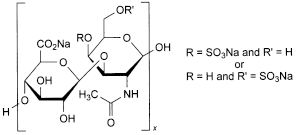
H2O(C14H19NNa2O14S)x 9082-07-9
Acid mucopolysaccharide; treatment of osteoarthritis.
Ph Eur
Natural copolymer based mainly on the 2 disaccharides: [4)-(β-d-glucopyranosyluronic acid)-(1→3)-[2-(acetylamino)-2-deoxy-β-d-galactopyranosyl 4-sulfate]-(1→] and [4)-(β-d-glucopyranosyluronic acid)-(1→3)-[2-(acetylamino)-2-deoxy-β-d-galactopyranosyl 6-sulfate]-(1→], sodium salt. On complete hydrolysis it liberates d-galactosamine, d-glucuronic acid, acetic acid and sulfuric acid. It is obtained from cartilage of both terrestrial and marine origins. Depending on the animal species of origin, it shows different proportions of 4-sulfate and 6-sulfate groups.
95 per cent to 105 per cent (dried substance).
The animals from which chondroitin sulfate sodium is derived must fulfil the requirements for the health of animals suitable for human consumption.
White or almost white, hygroscopic powder.
Freely soluble in water, practically insoluble in acetone and in ethanol (96 per cent).
A. Infrared absorption spectrophotometry (2.2.24).
Preparation Discs of potassium bromide R.
Comparison For chondroitin sulfate sodium of terrestrial origin use chondroitin sulfate sodium CRS and for chondroitin sulfate sodium of marine origine use chondroitin sulfate sodium (marine) CRS.
B. Solution S1 (see Tests) gives reaction (b) of sodium (2.3.1).
C. Examine the electropherograms obtained in the test for related substances.
Results The principal band in the electropherogram obtained with the test solution is similar in position to the principal band in the electropherogram obtained with reference solution (a).
Dissolve 2.500 g in 50.0 mL of carbon dioxide-free water R.
Dilute 1.0 mL of solution S1 to 10.0 mL with water R.
5.5 to 7.5 for solution S1.
- 20 to - 30 (terrestrial origin) or - 12 to - 19 (marine origin) (dried substance), determined on solution S1.
0.01 m3/kg to 0.15 m3/kg.
Test solution (a) Weigh 5.000 g (m0p) of the substance to be examined and add about 80 mL of an 11.7 g/L solution of sodium chloride R at room temperature. Dissolve by shaking at room temperature for 30 min. Dilute to 100.0 mL with an 11.7 g/L solution of sodium chloride R. Filter through a membrane filter (nominal pore size 0.45 µm) and discard the first 10 mL. The concentration of test solution (a) is only indicative and must be adjusted after an initial measurement of the viscosity of test solution (a).
Test solution (b) To 15.0 mL of test solution (a) add 5.0 mL of an 11.7 g/L solution of sodium chloride R.
Test solution (c) To 10.0 mL of test solution (a) add 10.0 mL of an 11.7 g/L solution of sodium chloride R.
Test solution (d) To 5.0 mL of test solution (a) add 15.0 mL of an 11.7 g/L solution of sodium chloride R.
Determine the flow-time (2.2.9) for an 11.7 g/L solution of sodium chloride R (t0) and the flow times for the 4 test solutions (t1, t2, t3 and t4), at 25.00 ± 0.03 °C. Use an appropriate suspended level viscometer (specifications: viscometer constant = about 0.005 mm2/s2, kinematic viscosity range = 1-5 mm2/s, internal diameter of tube R = 0.53 mm, volume of bulb C = 5.6 mL, internal diameter of tube N = 2.8-3.2 mm) with a funnel-shaped lower capillary end. Use the same viscometer for all measurements; measure all outflow times in triplicate. The test is not valid unless the results do not differ by more than 0.35 per cent from the mean and if the flow time t1 is not less than 1.6 × t0 and not more than 1.8 × t0. If this is not the case, adjust the concentration of test solution (a) and repeat the procedure.
Calculation of the relative viscosities Since the densities of the chondroitin sulfate solutions and of the solvent are almost equal, the relative viscosities ηri (being ηr1, ηr2, ηr3 and ηr4) can be calculated from the ratio of the flow times for the respective solutions ti (being t1, t2, t3 and t4) to the flow time of the solvent t0, but taking into account the kinetic energy correction factor for the capillary (B = 30 800 s3), as shown below:

Calculation of the concentrations Calculate the concentration c1 (expressed in kg/m3) of chondroitin sulfate sodium in test solution (a) using the following expression:

x |
= |
percentage content of chondroitin sulfate sodium as determined in the assay; |
h |
= |
loss on drying as a percentage. |
Calculate the concentration c2 (expressed in kg/m3) of chondroitin sulfate sodium in test solution (b) using the following expression:

Calculate the concentration c3 (expressed in kg/m3) of chondroitin sulfate sodium in test solution (c) using the following expression:

Calculate the concentration c4 (expressed in kg/m3) of chondroitin sulfate sodium in test solution (d) using the following expression:

Calculation of the intrinsic viscosity The specific viscosity ηsi of the test solution (being ηs1, ηs2, ηs3 and ηs4) is calculated from the relative viscosities ηri (being ηr1, ηr2, ηr3 and ηr4) according to the following expression:

The intrinsic viscosity [η], defined as
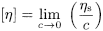
Is calculated by linear least-squares regression analysis using the following equation:
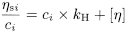
c i |
= |
concentration of the substance to be examined expressed in kg/m3; |
k H |
= |
Huggins' constant. |
Electrophoresis (2.2.31).
Buffer solution A (0.1 M barium acetate pH 5.0) Dissolve 25.54 g of barium acetate R in 900 mL of water R. Adjust to pH 5.0 with glacial acetic acid R and dilute to 1000.0 mL with water R.
Buffer solution B (1 M barium acetate pH 5.0) Dissolve 255.43 g of barium acetate R in 900 mL of water R. Adjust to pH 5.0 with glacial acetic acid R and dilute to 1000.0 mL with water R.
Staining solution Dissolve 1.0 g of toluidine blue R and 2.0 g of sodium chloride R in 1000 mL of 0.01 M hydrochloric acid. Filter.
Test solution Prepare a 30 mg/mL solution of the substance to be examined in water R.
Reference solution (a) Prepare a 30 mg/mL solution of chondroitin sulfate sodium CRS in water R.
Reference solution (b) Dilute 2.0 mL of reference solution (a) to 100.0 mL with water R.
Reference solution (c) Mix equal volumes of reference solution (b) and water R.
Procedure Allow the electrophoresis support to cool the plate to 10 °C. Pre-equilibrate the agarose gel for 1 min in buffer solution A. Remove excess liquid by careful decanting. Dry the gel for approximately 5 min. Place 400 mL of buffer solution B into each of the containers of the electrophoresis equipment. Transfer 1 µL of each solution to the slots of the agarose gel. Pipette a few millilitres of a 50 per cent V/V solution of glycerol R onto the cooled plate of the electrophoresis equipment and place the gel in the middle of the ceramic plate. Place a wick, saturated with buffer solution B, at the positive and negative sides of the agarose gel. Ensure that there is good contact between the electrophoresis buffer and the agarose gel. Perform the electrophoresis under the following conditions: 75 mA/gel, resulting in a voltage of 100-150 V (maximum 300-400 V) for a gel of about 12 cm × 10 cm. Carry out the electrophoresis for 12 min. Place the gel in a mixture consisting of 10 volumes of anhydrous ethanol R and 90 volumes of buffer solution A for 2 min. Carry out the electrophoresis for 20 min. Place the gel in a mixture consisting of 30 volumes of anhydrous ethanol R and 70 volumes of buffer solution A for 2 min. Carry out the electrophoresis for 20 min. Stain the gel in the staining solution for 10 min. Destain the gel for 15 min under running tap water followed by 10-15 min with water R until the band in the electropherogram obtained with reference solution (c) is visible. Allow the gel to dry.
- — the electropherogram obtained with reference solution (c) shows a visible band;
- — the band in the electropherogram obtained with reference solution (b) is clearly visible and similar in position to the band in the electropherogram obtained with reference solution (a).
Results Any secondary band in the electropherogram obtained with the test solution is not more intense than the band in the electropherogram obtained with reference solution (b) (2 per cent).
Maximum 3.0 per cent (dried substance).
Test solution Dilute 1.0 mL of solution S1 to 50.0 mL with 0.1 M sodium hydroxide.
Reference solutions Dissolve about 0.100 g of bovine albumin R, accurately weighed, in 0.1 M sodium hydroxide and dilute to 50.0 mL with the same solvent. Carry out all additional dilutions using 0.1 M sodium hydroxide.
Maximum 0.5 per cent.
Dilute 1 mL of solution S2 to 15 mL with water R. Do not add diluted nitric acid. Prepare the standard using 5 mL of chloride standard solution (5 ppm Cl) and 10 mL of water R.
Maximum 20 ppm.
1.0 g complies with test C. Prepare the reference solution using 2 mL of lead standard solution (10 ppm Pb) R.
Maximum 12.0 per cent, determined on 1.000 g by drying in an oven at 105 °C for 4 h.
TAMC: acceptance criterion 103 CFU/g (2.6.12).
TYMC: acceptance criterion 102 CFU/g (2.6.12).
Absence of Staphylococcus aureus (2.6.13).
Absence of Pseudomonas aeruginosa (2.6.13).
Absence of Escherichia coli (2.6.13).
Absence of Salmonella (2.6.13).
Absence of bile-tolerant gram-negative bacteria (2.6.13).
Test solution (a) Weigh 0.100 g (m1) of the substance to be examined, dissolve in water R and dilute to 100.0 mL with the same solvent.
Test solution (b) Dilute 5.0 mL of test solution (a) to 50.0 mL with water R.
Reference solution (a) Weigh 0.100 g (m0) of chondroitin sulfate sodium CRS, previously dried as described in the test for loss on drying, dissolve in water R and dilute to 100.0 mL with the same solvent.
Reference solution (b) Dilute 5.0 mL of reference solution (a) to 50.0 mL with water R.
Titrant solution (a) Weigh 4.000 g of cetylpyridinium chloride monohydrate R and dilute to 1000 mL with water R.
Titrant solution (b) Weigh 1.000 g of cetylpyridinium chloride monohydrate R and dilute to 1000 mL with water R.
Perform either visual or photometric titration as follows:
Visual titration Titrate 40.0 mL of reference solution (a) and 40.0 mL of test solution (a) with titrant solution (a). The solution becomes turbid. At the end point, the liquid appears clear, with an almost-white precipitate in suspension. The precipitate is more apparent if 0.1 mL of a 1 per cent solution of methylene blue R is added before starting the titration. The precipitated particles are more apparent against the blue background.
Photometric titration Titrate 50.0 mL of reference solution (b) and 50.0 mL of test solution (b) with titrant solution (b). To determine the end point, use a suitable autotitrator equipped with a phototrode at a suitable wavelength (none is critical) in the visible range.
Calculate the percentage content of chondroitin sulfate sodium using the following expression:
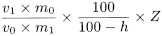
v 0 |
= |
volume of appropriate titrant solution when titrating the appropriate reference solution, in millilitres; |
v 1 |
= |
volume of appropriate titrant solution when titrating the appropriate test solution, in millilitres; |
h |
= |
loss on drying of the substance to be examined, as a percentage; |
Z |
= |
percentage content of H2O(C14H19NNa2O14S)x in chondroitin sulfate sodium CRS. |
In an airtight container, protected from light.
The label states the origin of the substance (marine or terrestrial).
Ph Eur