- British Pharmacopoeia Volume I & II
- Monographs: Medicinal and Pharmaceutical Substances
Crotamiton |
 |


(Ph. Eur. monograph 1194)
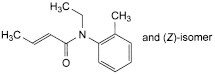
C13H17NO 203.3 483-63-6
Acaricide.
Ph Eur
N-Ethyl-N-(2-methylphenyl)but-2-enamide.
- — sum of the (E)- and (Z)-isomers: 96.0 per cent to 102.0 per cent;
- — (Z)-isomer: maximum 15.0 per cent.
Colourless or pale yellow, oily liquid.
Slightly soluble in water, miscible with ethanol (96 per cent).
At low temperatures it may partly or completely solidify.
First identification B.
Second identification A, C, D.
A. Ultraviolet and visible absorption spectrophotometry (2.2.25).
Test solution Dissolve 25.0 mg in cyclohexane R and dilute to 100.0 mL with the same solvent. Dilute 1.0 mL of this solution to 10.0 mL with cyclohexane R.
Spectral range 220-300 nm.
Absorption maximum At 242 nm.
Specific absorbance at the absorption maximum 300 to 330.
B. Infrared absorption spectrophotometry (2.2.24).
Comparison crotamiton CRS.
C. Thin-layer chromatography (2.2.27).
Test solution Dissolve 25 mg of the substance to be examined in anhydrous ethanol R and dilute to 10 mL with the same solvent.
Reference solution Dissolve 25 mg of crotamiton CRS in anhydrous ethanol R and dilute to 10 mL with the same solvent.
Plate TLC silica gel F254 plate R.
Mobile phase Shake 98 volumes of methylene chloride R with 2 volumes of concentrated ammonia R, dry over anhydrous sodium sulfate R, filter and mix 97 volumes of the filtrate with 3 volumes of 2-propanol R.
Application 5 µL.
Development Over a 2/3 of the plate.
Drying In air.
Detection Examine in ultraviolet light at 254 nm.
Results The principal spot in the chromatogram obtained with the test solution is similar in position and size to the principal spot in the chromatogram obtained with the reference solution.
D. To 10 mL of a saturated solution add a few drops of a 3 g/L solution of potassium permanganate R. A brown colour is produced and a brown precipitate is formed on standing.
1.006 to 1.011.
1.540 to 1.542.
Maximum 500 ppm, expressed as ethylaminotoluene.
Dissolve 5.00 g in 16 mL of methylene chloride R and add 4.0 mL of glacial acetic acid R. Add 0.1 mL of metanil yellow solution R and 1.0 mL of 0.02 M perchloric acid. The solution is red-violet.
Maximum 100 ppm.
Boil 5.0 g under a reflux condenser for 1 h with 25 mL of ethanol (96 per cent) R and 5 mL of a 200 g/L solution of sodium hydroxide R. Cool, add 5 mL of water R and shake with 25 mL of ether R. Dilute the lower layer to 20 mL with water R; add 5 mL of nitric acid R, dilute to 50 mL with water R and add 1 mL of a freshly prepared 50 g/L solution of silver nitrate R. Any opalescence in the solution is not more intense than that in a mixture of 1 mL of a freshly prepared 50 g/L solution of silver nitrate R and a solution prepared by diluting 5 mL of a 200 g/L solution of sodium hydroxide R to 20 mL with water R and adding 1.5 mL of 0.01 M hydrochloric acid, 5 mL of nitric acid R and diluting to 50 mL with water R.
Liquid chromatography (2.2.29).
Test solution (a) Dissolve 50.0 mg of the substance to be examined in the mobile phase and dilute to 100.0 mL with the mobile phase.
Test solution (b) Dilute 1.0 mL of test solution (a) to 20.0 mL with the mobile phase.
Reference solution (a) Dissolve 50.0 mg of crotamiton CRS in the mobile phase and dilute to 100.0 mL with the mobile phase. Dilute 1.0 mL of this solution to 20.0 mL with the mobile phase.
Reference solution (b) Dissolve 15.0 mg of crotamiton impurity A CRS in the mobile phase and dilute to 20.0 mL with the mobile phase. Dilute 1.0 mL of this solution to 50.0 mL with the mobile phase.
Reference solution (c) Dilute 1.0 mL of test solution (a) to 100.0 mL with the mobile phase.
Reference solution (d) Dissolve 15 mg of crotamiton impurity A CRS in the mobile phase and dilute to 100.0 mL with the mobile phase. Dilute 1.0 mL of this solution to 10.0 mL with test solution (a).
- — size: l = 0.25 m, Ø = 4 mm;
- — stationary phase: silica gel for chromatography R (5 µm).
Mobile phase tetrahydrofuran R, cyclohexane R (8:92 V/V).
Flow rate 1.0 mL/min.
Detection Spectrophotometer at 242 nm.
Injection 20 µL of test solution (a) and reference solutions (b), (c) and (d).
Run time 2.5 times the retention time of the (E)-isomer.
Relative retention With reference to the (E)-isomer: (Z)-isomer = about 0.5; impurity A = about 0.8.
System suitability Reference solution (d):
- — resolution: minimum 4.5 between the peaks due to impurity A and the (E)-isomer.
- — impurity A: not more than the area of the corresponding peak in the chromatogram obtained with reference solution (b) (3.0 per cent);
- — unspecified impurities: for each impurity, not more than 0.1 times the sum of the areas of the peaks due to the (Z)- and (E)- isomers in the chromatogram obtained with reference solution (c) (0.10 per cent);
- — sum of impurities other than A: not more than the sum of the areas of the peaks due to the (Z)- and (E)-isomers in the chromatogram obtained with reference solution (c) (1.0 per cent);
- — disregard limit: 0.02 times the sum of the areas of the peaks due to the (Z)- and (E)-isomers in the chromatogram obtained with reference solution (c) (0.02 per cent).
Maximum 0.1 per cent, determined on 1.0 g.
Liquid chromatography (2.2.29) as described in the test for related substances with the following modification.
Injection Test solution (b) and reference solution (a).
Calculate the percentage content of C13H17NO from the sum of the areas of the peaks due to the (Z)- and (E)-isomers in the chromatograms obtained. Calculate the content of the (Z)-isomer, as a percentage of the total content of the (E)- and (Z)-isomers, from the chromatogram obtained with test solution (b).
Protected from light.
Specified impurities A.
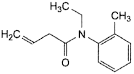
A. N-ethyl-N-(2-methylphenyl)but-3-enamide.
Ph Eur