- British Pharmacopoeia Volume I & II
- Monographs: Medicinal and Pharmaceutical Substances
Phenoxymethylpenicillin Potassium |
 |


(Ph. Eur. monograph 0149)
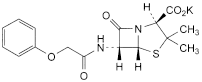
C16H17KN2O5S 388.5 132-98-9
Penicillin antibacterial.
Phenoxymethylpenicillin Oral Solution
Phenoxymethylpenicillin Tablets
Ph Eur
Potassium salt of (2S,5R,6R)-3,3-dimethyl-7-oxo-6-[(phenoxyacetyl)amino]-4-thia-1-azabicyclo[3.2.0]heptane-2-carboxylic acid.
Substance produced by the growth of certain strains of Penicillium notatum or related organisms on a culture medium containing an appropriate precursor, or obtained by any other means.
95.0 per cent to 102.0 per cent for the sum of the percentage contents of phenoxymethylpenicillin potassium and 4-hydroxyphenoxymethylpenicillin potassium (anhydrous substance).
White or almost white, crystalline powder.
Freely soluble in water, practically insoluble in ethanol (96 per cent).
First identification A, D.
Second identification B, C, D.
A. Infrared absorption spectrophotometry (2.2.24).
Comparison phenoxymethylpenicillin potassium CRS.
B. Thin-layer chromatography (2.2.27).
Test solution Dissolve 25 mg of the substance to be examined in 5 mL of water R.
Reference solution (a) Dissolve 25 mg of phenoxymethylpenicillin potassium CRS in 5 mL of water R.
Reference solution (b) Dissolve 25 mg of benzylpenicillin potassium CRS and 25 mg of phenoxymethylpenicillin potassium CRS in 5 mL of water R.
Plate TLC silanised silica gel plate R.
Mobile phase Mix 30 volumes of acetone R and 70 volumes of a 154 g/L solution of ammonium acetate R adjusted to pH 5.0 with glacial acetic acid R.
Application 1 µL.
Development Over a path of 15 cm.
Drying In air.
Detection Expose to iodine vapour until the spots appear and examine in daylight.
System suitability Reference solution (b):
- — the chromatogram shows 2 clearly separated spots.
Results The principal spot in the chromatogram obtained with the test solution is similar in position, colour and size to the principal spot in the chromatogram obtained with reference solution (a).
C. Place about 2 mg in a test-tube about 150 mm long and 15 mm in diameter. Moisten with 0.05 mL of water R and add 2 mL of sulfuric acid-formaldehyde reagent R. Mix the contents of the tube by swirling; the solution is reddish-brown. Place the test-tube in a water-bath for 1 min; a dark reddish-brown colour develops.
D. It gives reaction (a) of potassium (2.3.1).
5.5 to 7.5.
Dissolve 50 mg in carbon dioxide-free water R and dilute to 10 mL with the same solvent.
+ 215 to + 230 (anhydrous substance).
Dissolve 0.250 g in carbon dioxide-free water R and dilute to 25.0 mL with the same solvent.
Liquid chromatography (2.2.29).
Dissolution mixture To 250 mL of 0.2 M potassium dihydrogen phosphate R add 500 mL of water R and adjust to pH 6.5 with an 8.4 g/L solution of sodium hydroxide R. Dilute to 1000 mL with water R.
Test solution (a) Dissolve 50.0 mg of the substance to be examined in the dissolution mixture and dilute to 50.0 mL with the dissolution mixture.
Test solution (b) Prepare immediately before use. Dissolve 80.0 mg of the substance to be examined in the dissolution mixture and dilute to 20.0 mL with the dissolution mixture.
Reference solution (a) Dissolve 50.0 mg of phenoxymethylpenicillin potassium CRS in the dissolution mixture and dilute to 50.0 mL with the dissolution mixture.
Reference solution (b) Dissolve 4.0 mg of 4-hydroxyphenoxymethylpenicillin potassium CRS in the dissolution mixture and dilute to 10.0 mL with the dissolution mixture. Dilute 5.0 mL of this solution to 100.0 mL with the dissolution mixture.
Reference solution (c) Dissolve 10 mg of phenoxymethylpenicillin potassium CRS and 10 mg of benzylpenicillin sodium CRS (impurity A) in the dissolution mixture and dilute to 50 mL with the dissolution mixture.
Reference solution (d) Dilute 1.0 mL of reference solution (a) to 20 mL with the dissolution mixture. Dilute 1.0 mL of this solution to 50 mL with the dissolution mixture.
Reference solution (e) Dilute 1.0 mL of reference solution (a) to 25.0 mL with the dissolution mixture.
- — size: l = 0.25 m, Ø = 4.6 mm;
- — stationary phase: octadecylsilyl silica gel for chromatography R (5 µm).
- — mobile phase A: phosphate buffer solution pH 3.5 R, methanol R, water R (10:30:60 V/V/V);
- — mobile phase B: phosphate buffer solution pH 3.5 R, water R, methanol R (10:35:55 V/V/V);
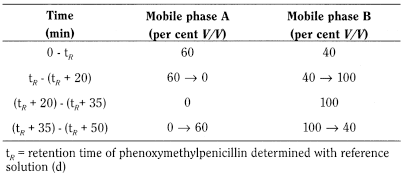
If the mobile phase composition has been adjusted to achieve the required resolution, the adjusted composition will apply at time zero in the gradient and in the assay.
Flow rate 1.0 mL/min.
Detection Spectrophotometer at 254 nm.
Injection 20 µL of reference solutions (c), (d) and (e) with isocratic elution at the initial mobile phase composition and 20 µL of test solution (b) according to the elution gradient described under Mobile phase; inject the dissolution mixture as a blank according to the elution gradient described under Mobile phase.
- — resolution: minimum 6.0 between the peaks due to impurity A and phenoxymethylpenicillin in the chromatogram obtained with reference solution (c); if necessary, adjust the ratio A:B of the mobile phase;
- — signal-to-noise ratio: minimum 3 for the principal peak in the chromatogram obtained with reference solution (d);
- — mass distribution ratio: 5.0 to 7.0 for the peak due to phenoxymethylpenicillin (2nd peak) in the chromatogram obtained with reference solution (c).
- — any impurity: for each impurity, not more than the area of the principal peak in the chromatogram obtained with reference solution (e) (1 per cent);
- — disregard limit: disregard the peak due to 4-hydroxyphenoxymethylpenicillin.
Liquid chromatography (2.2.29) as described in the test for related substances with the following modifications.
Mobile phase Initial composition of the mixture of mobile phases A and B, adjusted where applicable.
Injection Test solution (a) and reference solution (b).
- — 4-hydroxyphenoxymethylpenicillin potassium: maximum 4.0 per cent (anhydrous substance).
Calculate the percentage content by multiplying, if necessary, by the correction factor supplied with the CRS.
Maximum 1.0 per cent, determined on 1.000 g.
Liquid chromatography (2.2.29) as described in the test for related substances with the following modifications.
Mobile phase Initial composition of the mixture of mobile phases A and B, adjusted where applicable.
Injection Test solution (a) and reference solutions (a) and (b).
System suitability Reference solution (a):
- — repeatability: maximum relative standard deviation of 1.0 per cent after 6 injections.
Calculate the percentage content of phenoxymethylpenicillin potassium and of 4-hydroxyphenoxymethylpenicillin potassium.
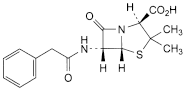
A. (2S,5R,6R)-3,3-dimethyl-7-oxo-6-[(phenylacetyl)amino]-4-thia-1-azabicyclo[3.2.0]heptane-2-carboxylic acid (benzylpenicillin),
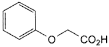
B. phenoxyacetic acid,
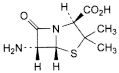
C. (2S,5R,6R)-6-amino-3,3-dimethyl-7-oxo-4-thia-1-azabicyclo[3.2.0]heptane-2-carboxylic acid (6-aminopenicillanic acid),
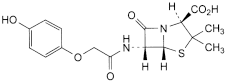
D. (2S,5R,6R)-3,3-dimethyl-7-oxo-6-[[2-(4-hydroxyphenoxy)acetyl]amino]-4-thia- 1-azabicyclo[3.2.0]heptane-2-carboxylic acid (4-hydroxyphenoxymethylpenicillin),
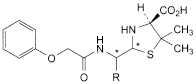
E. R = CO2H: (4S)-2-[carboxy[(phenoxyacetyl)amino]methyl]-5,5-dimethylthiazolidine-4-carboxylic acid (penicilloic acids of phenoxymethylpenicillin),
F. R = H: (2RS,4S)-5,5-dimethyl-2-[[(phenoxyacetyl)amino]methyl]thiazolidine-4-carboxylic acid (penilloic acids of phenoxymethylpenicillin).
Ph Eur