- British Pharmacopoeia Volume I & II
- Monographs: Medicinal and Pharmaceutical Substances
Pyridoxine Hydrochloride |
 |


(Ph. Eur. monograph 0245)
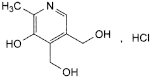
C8H11NO3,HCl 205.6 58-56-0
Vitamin B6.
When vitamin B6 is prescribed or demanded, Pyridoxine Hydrochloride shall be dispensed or supplied.
Ph Eur
(5-Hydroxy-6-methylpyridine-3,4-diyl)dimethanol hydrochloride.
99.0 per cent to 101.0 per cent (dried substance).
White or almost white, crystalline powder.
Freely soluble in water, slightly soluble in ethanol (96 per cent).
About 205 °C, with decomposition.
First identification B, D.
Second identification A, C, D.
A. Ultraviolet and visible absorption spectrophotometry (2.2.25).
Solution A Dilute 1.0 mL of solution S (see Tests) to 50.0 mL with 0.1 M hydrochloric acid.
Solution B Dilute 1.0 mL of solution A to 100.0 mL with 0.1 M hydrochloric acid.
Solution C Dilute 1.0 mL of solution A to 100.0 mL with the potassium dihydrogen phosphate 0.025 M + disodium hydrogen phosphate 0.025 M solution described in chapter 2.2.3.
Spectral ranges 250-350 nm for solution B; 220-350 nm for solution C.
Absorption maxima 288-296 nm for solution B; 248-256 nm and 320-327 nm for solution C.
- — 425-445 for solution B at 288-296 nm;
- — 175-195 for solution C at 248-256 nm;
- — 345-365 for solution C at 320-327 nm.
B. Infrared absorption spectrophotometry (2.2.24).
Comparison pyridoxine hydrochloride CRS.
C. Thin-layer chromatography (2.2.27).
Test solution Dissolve 1.0 g of the substance to be examined in water R and dilute to 10 mL with the same solvent. Dilute 1 mL of this solution to 10 mL with water R.
Reference solution Dissolve 0.10 g of pyridoxine hydrochloride CRS in water R and dilute to 10 mL with the same solvent.
Plate TLC silica gel G plate R.
Mobile phase concentrated ammonia R, methylene chloride R, tetrahydrofuran R, acetone R (9:13:13:65 V/V/V/V).
Application 2 µL.
Development In an unsaturated tank, over a path of 15 cm.
Drying In air.
Detection Spray with a 50 g/L solution of sodium carbonate R in a mixture of 30 volumes of ethanol (96 per cent) R and 70 volumes of water R; dry in a current of air, spray with a 1 g/L solution of dichloroquinonechlorimide R in ethanol (96 per cent) R and examine immediately.
Results The principal spot in the chromatogram obtained with the test solution is similar in position, colour and size to the principal spot in the chromatogram obtained with the reference solution.
D. Solution S gives reaction (a) of chlorides (2.3.1).
Dissolve 2.50 g in carbon dioxide-free water R and dilute to 50.0 mL with the same solvent.
Solution S is clear (2.2.1) and not more intensely coloured than reference solution Y7 (2.2.2, Method II).
2.4 to 3.0 for solution S.
Liquid chromatography (2.2.29).
Test solution Dissolve 25 mg of the substance to be examined in water R and dilute to 10.0 mL with the same solvent.
Reference solution (a) Dilute 1.0 mL of the test solution to 100.0 mL with water R. Dilute 1.0 mL of this solution to 10.0 mL with water R.
Reference solution (b) Dissolve 2.5 mg of pyridoxine impurity A CRS and 2.5 mg of 4-deoxypyridoxine hydrochloride R (impurity B) in water R and dilute to 10.0 mL with the same solvent. Dilute 2.0 mL of this solution to 10.0 mL with water R.
- — size: l = 0.25 m, Ø = 4.6 mm;
- — stationary phase: base-deactivated end-capped octadecylsilyl silica gel for chromatography R (5 µm).
Mobile phase Dissolve 2.72 g of potassium dihydrogen phosphate R in 900 mL of water R, adjust to pH 3.0 with dilute phosphoric acid R and dilute to 1000 mL with water R.
Flow rate 1.0 mL/min.
Detection Spectrophotometer at 210 nm.
Injection 5 µL.
Run time 2.5 times the retention time of pyridoxine.
Identification of impurities Use the chromatogram obtained with reference solution (b) to identify the peaks due to impurities A and B.
Relative retention With reference to pyridoxine (retention time = about 12 min): impurity A = about 1.7; impurity B = about 1.9.
System suitability Reference solution (b):
- — resolution: minimum 1.5 between the peaks due to impurities A and B.
- — correction factor: for the calculation of content, multiply the peak area of impurity B by 1.5;
- — impurity B: not more than 1.5 times the area of the principal peak in the chromatogram obtained with reference solution (a) (0.15 per cent);
- — unspecified impurities: for each impurity, not more than the area of the principal peak in the chromatogram obtained with reference solution (a) (0.10 per cent);
- — total: not more than twice the area of the principal peak in the chromatogram obtained with reference solution (a) (0.2 per cent);
- — disregard limit: 0.5 times the area of the principal peak in the chromatogram obtained with reference solution (a) (0.05 per cent).
Maximum 20 ppm.
12 mL of solution S complies with test A. Prepare the reference solution using lead standard solution (1 ppm Pb) R.
Maximum 0.5 per cent, determined on 1.000 g by drying in an oven at 105 °C.
Maximum 0.1 per cent, determined on 1.0 g.
In order to avoid overheating in the reaction medium, mix thoroughly throughout and stop the titration immediately after the end-point has been reached.
Dissolve 0.150 g in 5 mL of anhydrous formic acid R. Add 50 mL of acetic anhydride R. Titrate with 0.1 M perchloric acid, determining the end-point potentiometrically (2.2.20). Carry out a blank titration.
1 mL of 0.1 M perchloric acid is equivalent to 20.56 mg of C8H12ClNO3.
Protected from light.
Specified impurities B.
Other detectable impurities (the following substances would, if present at a sufficient level, be detected by one or other of the tests in the monograph. They are limited by the general acceptance criterion for other/unspecified impurities and/or by the general monograph Substances for pharmaceutical use (2034). It is therefore not necessary to identify these impurities for demonstration of compliance. See also 5.10. Control of impurities in substances for pharmaceutical use): A.

A. 6-methyl-1,3-dihydrofuro[3,4-c]pyridin-7-ol,
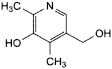
B. 5-(hydroxymethyl)-2,4-dimethylpyridin-3-ol.
Ph Eur