- British Pharmacopoeia Volume I & II
- Monographs: Medicinal and Pharmaceutical Substances
Salicylic Acid |
 |


(Ph. Eur. monograph 0366)

C7H6O3 138.1 69-72-7
Keratolytic.
Coal Tar and Salicylic Acid Ointment
Ph Eur
2-Hydroxybenzenecarboxylic acid.
99.0 per cent to 100.5 per cent (dried substance).
White or almost white, crystalline powder or white or colourless, acicular crystals.
Slightly soluble in water, freely soluble in ethanol (96 per cent), sparingly soluble in methylene chloride.
First identification A, B.
Second identification A, C.
A. Melting point (2.2.14): 158 °C to 161 °C.
B. Infrared absorption spectrophotometry (2.2.24).
Comparison salicylic acid CRS.
C. Dissolve about 30 mg in 5 mL of 0.05 M sodium hydroxide, neutralise if necessary and dilute to 20 mL with water R. 1 mL of the solution gives reaction (a) of salicylates (2.3.1).
Dissolve 2.5 g in 50 mL of boiling distilled water R, cool and filter.
The solution is clear (2.2.1) and colourless (2.2.2, Method II).
Dissolve 1 g in 10 mL of ethanol (96 per cent) R.
Liquid chromatography (2.2.29).
Test solution Dissolve 0.50 g of the substance to be examined in the mobile phase and dilute to 100.0 mL with the mobile phase.
Reference solution (a) Dissolve 10 mg of phenol R (impurity C) in the mobile phase and dilute to 100.0 mL with the mobile phase.
Reference solution (b) Dissolve 5 mg of salicylic acid impurity B CRS in the mobile phase and dilute to 20.0 mL with the mobile phase.
Reference solution (c) Dissolve 50 mg of 4-hydroxybenzoic acid R (impurity A) in the mobile phase and dilute to 100.0 mL with the mobile phase.
Reference solution (d) Dilute 1.0 mL of reference solution (a) to 10.0 mL with the mobile phase.
Reference solution (e) Dilute a mixture of 1.0 mL of each of reference solutions (a), (b) and (c) to 10.0 mL with the mobile phase.
Reference solution (f) Dilute a mixture of 0.1 mL of each of reference solutions (a), (b) and (c) to 10.0 mL with the mobile phase.
- — size: l = 0.15 m, Ø = 4.6 mm;
- — stationary phase: non-deactivated octadecylsilyl silica gel for chromatography R (5 µm).
Mobile phase glacial acetic acid R, methanol R, water R (1:40:60 V/V/V).
Flow rate 0.5 mL/min.
Detection Spectrophotometer at 270 nm.
Injection 10 µL of the test solution and reference solutions (d), (e) and (f).
Relative retention With reference to impurity C: impurity A = about 0.70; impurity B = about 0.90.
System suitability Reference solution (e):
- — the 3rd peak in the chromatogram corresponds to the peak due to phenol in the chromatogram obtained with reference solution (d);
- — resolution: minimum 1.0 between the peaks due to impurities B and C; if necessary, adjust the quantity of acetic acid in the mobile phase.
- — impurity A: not more than the area of the corresponding peak in the chromatogram obtained with reference solution (f) (0.1 per cent);
- — impurity B: not more than the area of the corresponding peak in the chromatogram obtained with reference solution (f) (0.05 per cent);
- — impurity C: not more than the area of the corresponding peak in the chromatogram obtained with reference solution (f) (0.02 per cent);
- — any other impurity: for each impurity, not more than the area of the peak due to impurity B in the chromatogram obtained with reference solution (f) (0.05 per cent);
- — total: not more than twice the area of the peak due to impurity A in the chromatogram obtained with reference solution (f) (0.2 per cent);
- — disregard limit: 0.01 times the area of the principal peak in the chromatogram obtained with reference solution (f).
Maximum 100 ppm.
Dilute 10 mL of solution S to 15 mL with water R.
Maximum 200 ppm.
Dissolve 1.0 g in 5 mL of dimethylformamide R and add 4 mL of water R. Mix thoroughly. Add 0.2 mL of dilute hydrochloric acid R and 0.5 mL of a 25 per cent m/m solution of barium chloride R. After 15 min any opalescence in the solution is not more intense than that in a standard prepared as follows: to 2 mL of sulfate standard solution (100 ppm SO4) R add 0.2 mL of dilute hydrochloric acid R, 0.5 mL of a 25 per cent m/m solution of barium chloride R, 3 mL of water R and 5 mL of dimethylformamide R.
Maximum 20 ppm.
Dissolve 2.0 g in 15 mL of ethanol (96 per cent) R and add 5 mL of water R. 12 mL of the solution complies with test B. Prepare the reference solution using lead standard solution (2 ppm Pb) prepared by diluting lead standard solution (100 ppm Pb) R with a mixture of 5 volumes of water R and 15 volumes of ethanol (96 per cent) R.
Maximum 0.5 per cent, determined on 1.000 g by drying in a desiccator.
Maximum 0.1 per cent, determined on 2.0 g.
Dissolve 0.120 g in 30 mL of ethanol (96 per cent) R and add 20 mL of water R. Titrate with 0.1 M sodium hydroxide, using 0.1 mL of phenol red solution R as indicator.
1 mL of 0.1 M sodium hydroxide is equivalent to 13.81 mg of C7H6O3.
Protected from light.
Specified impurities A, B, C.
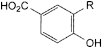
A. R = H: 4-hydroxybenzoic acid,
B. R = CO2H: 4-hydroxyisophthalic acid,

C. phenol.
Ph Eur