- British Pharmacopoeia Volume I & II
- Monographs: Medicinal and Pharmaceutical Substances
Thiamine Hydrochloride |
 |


(Ph. Eur. monograph 0303)
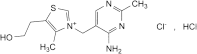
C12H17ClN4OS,HCl 337.3 67-03-8
Vitamin B1.
Ph Eur
3-[(4-Amino-2-methylpyrimidin-5-yl)methyl]-5-(2-hydroxyethyl)-4-methylthiazolium chloride hydrochloride.
98.5 per cent to 101.0 per cent (anhydrous substance).
White or almost white, crystalline powder or colourless crystals.
Freely soluble in water, soluble in glycerol, slightly soluble in ethanol (96 per cent).
First identification A, C.
Second identification B, C.
A. Infrared absorption spectrophotometry (2.2.24).
Comparison thiamine hydrochloride CRS.
If the spectra obtained show differences, dissolve the substance to be examined and the reference substance separately in water R, evaporate to dryness and record new spectra using the residues.
B. Dissolve about 20 mg in 10 mL of water R, add 1 mL of dilute acetic acid R and 1.6 mL of 1 M sodium hydroxide, heat on a water-bath for 30 min and allow to cool. Add 5 mL of dilute sodium hydroxide solution R, 10 mL of potassium ferricyanide solution R and 10 mL of butanol R and shake vigorously for 2 min. The upper alcoholic layer shows an intense light-blue fluorescence, especially in ultraviolet light at 365 nm. Repeat the test using 0.9 mL of 1 M sodium hydroxide and 0.1 g of anhydrous sodium sulfite R instead of 1.6 mL of 1 M sodium hydroxide. Practically no fluorescence is seen.
C. It gives reaction (a) of chlorides (2.3.1).
Dissolve 2.5 g in distilled water R and dilute to 25 mL with the same solvent.
The solution is clear (2.2.1) and not more intensely coloured than reference solution Y7 or GY7 (2.2.2, Method II).
Dilute 2.5 mL of solution S to 5 mL with water R.
2.7 to 3.3.
Dilute 2.5 mL of solution S to 10 mL with water R.
Liquid chromatography (2.2.29).
Solution A glacial acetic acid R, water R (5:95 V/V).
Test solution Dissolve 0.35 g of the substance to be examined in 15.0 mL of solution A and dilute to 100.0 mL with water R.
Reference solution (a) Dissolve 5 mg of the substance to be examined and 5 mg of thiamine impurity E CRS in 4 mL of solution A and dilute to 25.0 mL with water R. Dilute 5.0 mL of the solution to 25.0 mL with water R.
Reference solution (b) Dilute 1.0 mL of the test solution to 50.0 mL with water R. Dilute 5.0 mL of this solution to 25.0 mL with water R.
- — size: l = 0.25 m, Ø = 4.0 mm;
- — stationary phase: spherical end-capped octadecylsilyl silica gel for chromatography R (5 µm) with a specific surface area of 350 m2/g and a pore size of 10 nm;
- — temperature: 45 °C.
- — mobile phase A: 3.764 g/L solution of sodium hexanesulfonate R adjusted to pH 3.1 with phosphoric acid R;
- — mobile phase B: methanol R2;
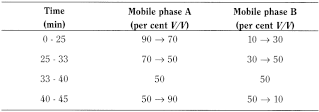
Flow rate 1.0 mL/min.
Detection Spectrophotometer at 248 nm.
Injection 25 µL.
Relative retention With reference to thiamine (retention time = about 30 min): impurity A = about 0.3; impurity B = about 0.9; impurity C = about 1.2.
System suitability Reference solution (a):
- — resolution: minimum 1.6 between the peaks due to impurity E and to thiamine.
- — any impurity: not more than the area of the principal peak in the chromatogram obtained with reference solution (b) (0.4 per cent);
- — total: not more than 2.5 times the area of the principal peak in the chromatogram obtained with reference solution (b) (1.0 per cent);
- — disregard limit: 0.125 times the area of the principal peak in the chromatogram obtained with reference solution (b) (0.05 per cent).
Maximum 300 ppm.
Dilute 5 mL of solution S to 15 mL with distilled water R.
Maximum 20 ppm.
12 mL of solution S complies with test A. Prepare the reference solution using lead standard solution (2 ppm Pb) R.
Maximum 5.0 per cent, determined on 0.400 g.
Maximum 0.1 per cent, determined on 1.0 g.
Dissolve 0.110 g in 5 mL of anhydrous formic acid R and add 50 mL of acetic anhydride R. Titrate immediately with 0.1 M perchloric acid, determining the end-point potentiometrically (2.2.20) and carrying out the titration within 2 min. Carry out a blank titration.
1 mL of 0.1 M perchloric acid is equivalent to 16.86 mg of C12H18Cl2N4OS.
In a non-metallic container, protected from light.
Specified impurities A, B, C.
Other detectable impurities (the following substances would, if present at a sufficient level, be detected by one or other of the tests in the monograph. They are limited by the general acceptance criterion for other/unspecified impurities and/or by the general monograph Substances for pharmaceutical use (2034). It is therefore not necessary to identify these impurities for demonstration of compliance. See also 5.10. Control of impurities in substances for pharmaceutical use): D, E, F, G, H.
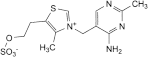
A. 3-[(4-amino-2-methylpyrimidin-5-yl)methyl]-4-methyl-5-[2-(sulfonatooxy)ethyl]thiazolium (thiamine sulfate ester),
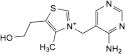
B. 3-[(4-aminopyrimidin-5-yl)methyl]-5-(2-hydroxyethyl)-4-methylthiazolium (desmethylthiamine),
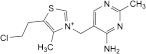
C. 3-[(4-amino-2-methylpyrimidin-5-yl)methyl]-5-(2-chloroethyl)-4-methylthiazolium (chlorothiamine),
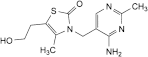
D. 3-[(4-amino-2-methylpyrimidin-5-yl)methyl]-5-(2-hydroxyethyl)-4-methylthiazol-2(3H)-one (oxothiamine),
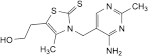
E. 3-[(4-amino-2-methylpyrimidin-5-yl)methyl]-5-(2-hydroxyethyl)-4-methylthiazol-2(3H)-thione (thioxothiamine),
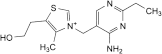
F. 3-[(4-amino-2-ethylpyrimidin-5-yl)methyl]-5-(2-hydroxyethyl)-4-methylthiazolium (ethylthiamine),
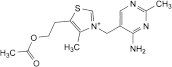
G. 5-[2-(acetyloxy)ethyl]-3-[(4-amino-2-methylpyrimidin-5-yl)methyl]-4-methylthiazolium (acetylthiamine),
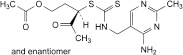
H. (3RS)-3-[[[(4-amino-2-methylpyrimidin-5-yl)methyl]thiocarbamoyl]sulfanyl]-4-oxopentyl acetate (ketodithiocarbamate).
Ph Eur