- British Pharmacopoeia Volume I & II
- Monographs: Medicinal and Pharmaceutical Substances
Water for Injections |
 |


(Ph. Eur. monograph 0169)
H2O 18.02 7732-18-5
Ph Eur
Water for the preparation of medicines for parenteral administration when water is used as vehicle (water for injections in bulk) and for dissolving or diluting substances or preparations for parenteral administration (sterilised water for injections).
Water for injections in bulk is obtained from water that complies with the regulations on water intended for human consumption laid down by the competent authority or from purified water by distillation in an apparatus of which the parts in contact with the water are of neutral glass, quartz or a suitable metal and which is fitted with an effective device to prevent the entrainment of droplets. The correct maintenance of the apparatus is essential. The first portion of the distillate obtained when the apparatus begins to function is discarded and the distillate is collected.
In order to ensure the appropriate quality of the water, validated procedures and in-process-monitoring of the electrical conductivity and regular microbial monitoring are applied.
Water for injections in bulk is stored and distributed in conditions designed to prevent growth of micro-organisms and to avoid any other contamination.
During production and subsequent storage, appropriate measures are taken to ensure that the microbial count is adequately controlled and monitored. Appropriate alert and action levels are set so as to detect adverse trends. Under normal conditions, an appropriate action level is a microbial count of 10 CFU per 100 mL when determined by filtration through a membrane with a nominal pore size not greater than 0.45 µm, using R2A agar, using at least 200 mL of water for injections in bulk and incubating at 30-35 °C for not less than 5 days. For aseptic processing, stricter alert levels may need to be applied.
R2A agar |
|
Yeast extract |
0.5 g |
Proteose peptone |
0.5 g |
Casein hydrolysate |
0.5 g |
Glucose |
0.5 g |
Starch |
0.5 g |
Dipotassium hydrogen phosphate |
0.3 g |
Magnesium sulfate, anhydrous |
0.024 g |
Sodium pyruvate |
0.3 g |
Agar |
15.0 g |
Purified water |
to 1000 mL |
Adjust the pH so that after sterilisation it is 7.2 ± 0.2. Sterilise by heating in an autoclave at 121 °C for 15 min.
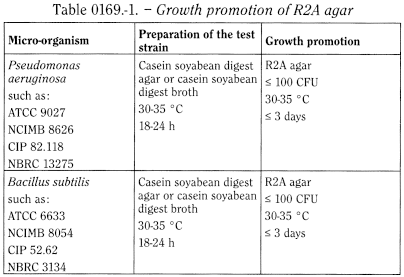
- — Preparation of test strains. Use standardised stable suspensions of test strains or prepare them as stated in Table 0169.-1. Seed lot culture maintenance techniques (seed-lot systems) are used so that the viable micro-organisms used for inoculation are not more than 5 passages removed from the original master seed-lot. Grow each of the bacterial strains separately as described in Table 0169.-1. Use buffered sodium chloride-peptone solution pH 7.0 or phosphate buffer solution pH 7.2 to make test suspensions. Use the suspensions within 2 h, or within 24 h if stored at 2-8 °C. As an alternative to preparing and then diluting a fresh suspension of vegetative cells of Bacillus subtilis, a stable spore suspension is prepared and then an appropriate volume of the spore suspension is used for test inoculation. The stable spore suspension may be maintained at 2-8 °C for a validated period of time.
- — Growth promotion. Test each batch of ready-prepared medium and each batch of medium, prepared either from dehydrated medium or from the ingredients described. Inoculate plates of R2A agar separately with a small number (not more than 100 CFU) of the micro-organisms indicated in Table 0169.-1. Incubate under the conditions described in the table. Growth obtained must not differ by a factor greater than 2 from the calculated value for a standardised inoculum. For a freshly prepared inoculum, growth of the micro-organisms must be comparable to that obtained with a previously tested and approved batch of medium.
Maximum 0.5 mg/L.
Determine the conductivity off-line or in-line under the following conditions.
- — electrodes of a suitable material such as stainless steel;
- — cell constant: the cell constant is generally certified by the supplier and is subsequently verified at suitable intervals using a certified reference solution with a conductivity less than 1500 µS·cm-1 or by comparison with a cell having a certified cell constant. The cell constant is confirmed if the value found is within 2 per cent of the certified value, otherwise re-calibration must be performed.
Conductometer Accuracy of 0.1 µS·cm-1 or better at the lowest range.
- — against one or more suitable certified reference solutions;
- — accuracy: within 3 per cent of the measured conductivity plus 0.1 µS·cm-1.
Conductometer calibration Calibration is carried out for each range of measurement to be used, after disconnection of the conductivity cell, using certified precision resistors or equivalent devices with an uncertainty not greater than 0.1 per cent of the certified value.
If in-line conductivity cells cannot be dismantled, system calibration may be performed against a calibrated conductivity-measuring instrument with a conductivity cell placed close to the cell to be calibrated in the water flow.
Temperature measurement Tolerance ± 2 °C.
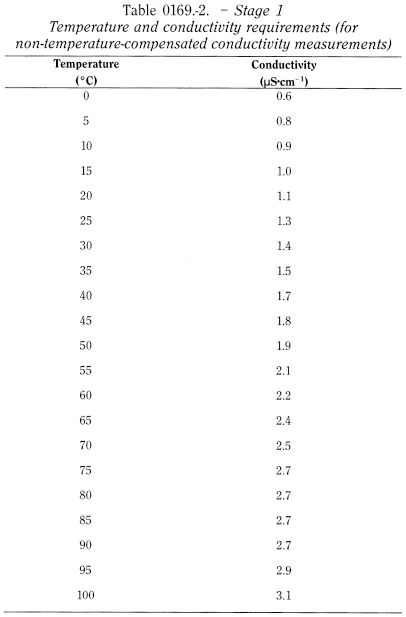
1. Measure the conductivity without temperature compensation, recording simultaneously the temperature. Temperature-compensated measurement may be performed after suitable validation.
2. Using Table 0169.-2, find the closest temperature value that is not greater than the measured temperature. The corresponding conductivity value is the limit at that temperature.
3. If the measured conductivity is not greater than the value in Table 0169.-2, the water to be examined meets the requirements of the test for conductivity. If the conductivity is higher than the value in Table 0169.-2, proceed with stage 2.
4. Transfer a sufficient amount of the water to be examined (100 mL or more) to a suitable container, and stir the test sample. Adjust the temperature, if necessary, and while maintaining it at 25 ± 1 °C, begin vigorously agitating the test sample while periodically observing the conductivity. When the change in conductivity (due to uptake of atmospheric carbon dioxide) is less than 0.1 µS.cm-1 per 5 min, note the conductivity.
5. If the conductivity is not greater than 2.1 µS.cm-1, the water to be examined meets the requirements of the test for conductivity. If the conductivity is greater than 2.1 µS.cm-1, proceed with stage 3.
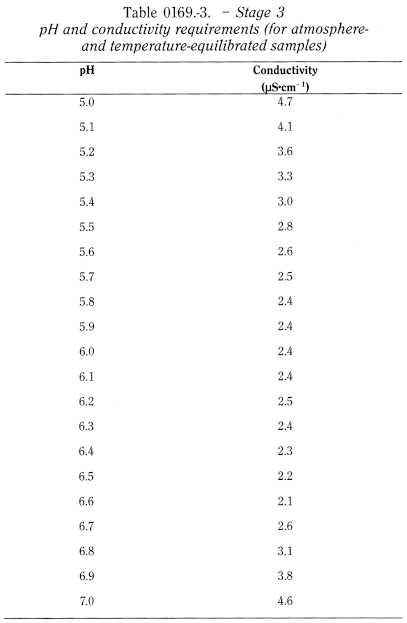
6. Perform this test within approximately 5 min of the conductivity determination in step 5 under stage 2, while maintaining the sample temperature at 25 ± 1 °C. Add a recently prepared saturated solution of potassium chloride R to the test sample (0.3 mL per 100 mL of the test sample), and determine the pH (2.2.3) to the nearest 0.1 pH unit.
7. Using Table 0169.-3, determine the conductivity limit at the measured pH value in step 6. If the measured conductivity in step 4 under stage 2 is not greater than the conductivity requirements for the pH determined, the water to be examined meets the requirements of the test for conductivity. If either the measured conductivity is greater than this value or the pH is outside the range of 5.0-7.0, the water to be examined does not meet the requirements of the test for conductivity.
Clear and colourless liquid.
Maximum 0.2 ppm.
Place 5 mL in a test-tube immersed in iced water, add 0.4 mL of a 100 g/L solution of potassium chloride R, 0.1 mL of diphenylamine solution R and, dropwise with shaking, 5 mL of nitrogen-free sulfuric acid R. Transfer the tube to a water-bath at 50 °C. After 15 min, any blue colour in the solution is not more intense than that in a reference solution prepared at the same time in the same manner using a mixture of 4.5 mL of nitrate-free water R and 0.5 mL of nitrate standard solution (2 ppm NO3) R.
Maximum 10 ppb, if intended for use in the manufacture of dialysis solutions.
Prescribed solution To 400 mL of the water to be examined add 10 mL of acetate buffer solution pH 6.0 R and 100 mL of distilled water R.
Reference solution Mix 2 mL of aluminium standard solution (2 ppm Al) R, 10 mL of acetate buffer solution pH 6.0 R and 98 mL of distilled water R.
Blank solution Mix 10 mL of acetate buffer solution pH 6.0 R and 100 mL of distilled water R.
Less than 0.25 IU/mL.
Water for injections in bulk that has been distributed into suitable containers, closed and sterilised by heat in conditions which ensure that the product still complies with the test for bacterial endotoxins. Sterilised water for injections is free from any added substances.
Examined in suitable conditions of visibility, it is clear and colourless.
Each container contains a sufficient quantity of water for injections to permit the nominal volume to be withdrawn.
To 20 mL add 0.05 mL of phenol red solution R. If the solution is yellow, it becomes red on the addition of 0.1 mL of 0.01 M sodium hydroxide; if red, it becomes yellow on the addition of 0.15 mL of 0.01 M hydrochloric acid.
Maximum 25 µS·cm-1 for containers with a nominal volume of 10 mL or less; maximum 5 µS·cm-1 for containers with a nominal volume greater than 10 mL.
Use equipment and the calibration procedure as defined under Water for injections in bulk, maintaining the sample temperature at 25 ± 1 °C.
For containers with a nominal volume less than 50 mL: heat 100 mL to boiling with 10 mL of dilute sulfuric acid R, add 0.4 mL of 0.02 M potassium permanganate and boil for 5 min; the solution remains faintly pink.
For containers with a nominal volume equal to or greater than 50 mL: heat 100 mL to boiling with 10 mL of dilute sulfuric acid R, add 0.2 mL of 0.02 M potassium permanganate and boil for 5 min; the solution remains faintly pink.
Maximum 0.5 ppm for containers with a nominal volume of 100 mL or less.
15 mL complies with the limit test for chlorides. Prepare the standard using a mixture of 1.5 mL of chloride standard solution (5 ppm Cl) R and 13.5 mL of water R. Examine the solutions down the vertical axes of the tubes.
For containers with a nominal volume greater than 100 mL, use the following test: to 10 mL add 1 mL of dilute nitric acid R and 0.2 mL of silver nitrate solution R2. The solution shows no change in appearance for at least 15 min.
Maximum 0.2 ppm.
Place 5 mL in a test-tube immersed in iced water, add 0.4 mL of a 100 g/L solution of potassium chloride R, 0.1 mL of diphenylamine solution R and, dropwise with shaking, 5 mL of nitrogen-free sulfuric acid R. Transfer the tube to a water-bath at 50 °C. After 15 min, any blue colour in the solution is not more intense than that in a reference solution prepared at the same time in the same manner using a mixture of 4.5 mL of nitrate-free water R and 0.5 mL of nitrate standard solution (2 ppm NO3) R.
To 10 mL add 0.1 mL of dilute hydrochloric acid R and 0.1 mL of barium chloride solution R1. The solution shows no change in appearance for at least 1 h.
Maximum 10 ppb, if intended for use in the manufacture of dialysis solutions.
Prescribed solution To 400 mL of the water to be examined add 10 mL of acetate buffer solution pH 6.0 R and 100 mL of distilled water R.
Reference solution Mix 2 mL of aluminium standard solution (2 ppm Al) R, 10 mL of acetate buffer solution pH 6.0 R and 98 mL of distilled water R.
Blank solution Mix 10 mL of acetate buffer solution pH 6.0 R and 100 mL of distilled water R.
For containers with a nominal volume less than 50 mL: maximum 0.6 ppm; for containers with a nominal volume equal to or greater than 50 mL: maximum 0.2 ppm.
Containers with a nominal volume less than 50 mL: to 20 mL add 1 mL of alkaline potassium tetraiodomercurate solution R; after 5 min, examine the solution down the vertical axis of the tube; the solution is not more intensely coloured than a standard prepared at the same time by adding 1 mL of alkaline potassium tetraiodomercurate solution R to a mixture of 4 mL of ammonium standard solution (3 ppm NH4) R and 16 mL of ammonium-free water R.
Containers with a nominal volume equal to or greater than 50 mL: to 20 mL add 1 mL of alkaline potassium tetraiodomercurate solution R; after 5 min, examine the solution down the vertical axis of the tube; the solution is not more intensely coloured than a standard prepared at the same time by adding 1 mL of alkaline potassium tetraiodomercurate solution R to a mixture of 4 mL of ammonium standard solution (1 ppm NH4) R and 16 mL of ammonium-free water R.
To 100 mL add 2 mL of ammonium chloride buffer solution pH 10.0 R, 50 mg of mordant black 11 triturate R and 0.5 mL of 0.01 M sodium edetate. A pure blue colour is produced.
Maximum 4 mg (0.004 per cent) for containers with a nominal volume of 10 mL or less; maximum 3 mg (0.003 per cent) for containers with a nominal volume greater than 10 mL.
Evaporate 100 mL to dryness on a water-bath and dry in an oven at 100-105 °C.
It complies with test A or test B, as appropriate.
It complies with the test for sterility.
Less than 0.25 IU/mL.
Ph Eur