- British Pharmacopoeia Volume III
- Formulated Preparations: Specific Monographs
Prolonged-release Ibuprofen Capsules |


Prolonged-release Ibuprofen Capsules from different manufacturers, whilst complying with the requirements of the monograph, are not interchangeable unless otherwise justified and authorised.
Cyclo-oxygenase inhibitor; analgesic; anti-inflammatory.
Prolonged-release Ibuprofen Capsules contain Ibuprofen. They are formulated so that the medicament is released over a period of several hours.
A suitable dissolution test is carried out to demonstrate the appropriate release of Ibuprofen. The dissolution profile reflects the in vivo performance which in turn is compatible with the dosage schedule recommended by the manufacturer.
The capsules comply with the requirements stated under Capsules and with the following requirements.
95.0 to 105.0% of the stated amount.
Extract a quantity of the capsule contents containing 0.5 g of Ibuprofen with 20 mL of acetone, filter and evaporate the filtrate to dryness in a current of air without heating. The infrared absorption spectrum of the residue, Appendix II A, is concordant with the reference spectrum of ibuprofen (RS 186).
Carry out the method for liquid chromatography, Appendix III D, using the following solutions.
(1) Dissolve a quantity of the capsule contents containing 20 mg of Ibuprofen in 2 mL of acetonitrile for chromatography and add sufficient mobile phase A to produce 10 mL.
(2) Dilute 1 volume of solution (1) to 100 volumes with mobile phase A.
(3) Dissolve 20 mg of ibuprofen BPCRS in 2 mL of acetonitrile for chromatography, add 1 mL of a 0.006% w/v solution of ibuprofen impurity B BPCRS in acetonitrile for chromatography (prepared by diluting 1 volume of ibuprofen impurity B BPCRS to 10 volumes with acetonitrile for chromatography) and sufficient mobile phase A to produce 10 mL.
(a) Use stainless steel column (15 cm × 4.6 mm) packed with octadecylsilyl silica gel for chromatography (5 µm) (Spherisorb ODS 2 is suitable).
(b) Use gradient elution and the mobile phase described below.
(c) Use a flow rate of 2 mL per minute.
(d) Use an ambient column temperature.
(e) Use a detection wavelength of 214 nm.
(f) Inject 20 µL of each solution.
(g) Equilibrate the column with mobile phase A for about 45 minutes.
Mobile phase A 0.5 volume of orthophosphoric acid, 340 volumes of acetonitrile for chromatography and 600 volumes of water. Allow to equilibrate and add sufficient water to produce 1000 mL.
Mobile phase B acetonitrile.
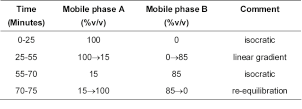
The test is not valid unless, in the chromatogram obtained with solution (3), the peak-to-valley ratio between the peaks due to ibuprofen and ibuprofen impurity B is not less than 1.5.
In the chromatogram obtained with solution (1):
the area of any peak corresponding to ibuprofen impurity B is not greater than the area of the peak corresponding to impurity B in the chromatogram obtained with solution (3) (0.3%);
the area of any other secondary peak is not greater than 0.3 times the area of the principal peak in the chromatogram obtained with solution (2) (0.3%);
the sum of the areas of any other secondary peaks is not greater than 0.7 times the area of the principal peak in the chromatogram obtained with solution (2) (0.7%).
Disregard any peak with an area less than 0.05 times the area of the principal peak in the chromatogram obtained with solution (2) (0.05%).
Carry out the method for liquid chromatography, Appendix III D, using the following solutions.
(1) Shake a quantity of the mixed contents of 20 capsules containing 0.2 g of Ibuprofen in 30 mL of mobile phase for 30 minutes. Add sufficient mobile phase to produce 100 mL and mix. Centrifuge an aliquot of the suspension at 2500 g for 5 minutes and use the supernatant liquid.
(2) 0.2% w/v of ibuprofen BPCRS in the mobile phase.
(a) Use a stainless steel column (25 cm × 4.6 mm) packed with octadecylsilyl silica gel for chromatography (10 µm) (Nucleosil C18 is suitable).
(b) Use isocratic elution and the mobile phase described below.
(c) Use a flow rate of 1.5 mL per minute.
(d) Use an ambient column temperature.
(e) Use a detection wavelength of 264 nm.
(f) Inject 20 µL of each solution.
3 volumes of orthophosphoric acid, 247 volumes of water and 750 volumes of methanol.
Calculate the content of C13H18O2 in the capsules using the declared content of C13H18O2 in ibuprofen BPCRS.
The impurities limited by the requirements of this monograph include:
(2RS)-2-(4-butylphenyl)propanoic acid (Ibuprofen Impurity B).