- British Pharmacopoeia Volume I & II
- Monographs: Medicinal and Pharmaceutical Substances
Cefalexin Monohydrate |
 |
(Ph. Eur. monograph 0708)
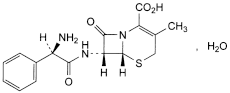
C16H17N3O4S,H2O 365.4 23325-78-2
Cephalosporin antibacterial.
Ph Eur
(6R,7R)-7-[[(2R)-2-Amino-2-phenylacetyl]amino]-3-methyl-8-oxo-5-thia-1-azabicyclo[4.2.0]oct-2-ene-2-carboxylic acid monohydrate.
Semi-synthetic product derived from a fermentation product.
95.0 per cent to 102.0 per cent (anhydrous substance).
White or almost white, crystalline powder.
Sparingly soluble in water, practically insoluble in ethanol (96 per cent).
Infrared absorption spectrophotometry (2.2.24).
Comparison cefalexin monohydrate CRS.
4.0 to 5.5.
Dissolve 50 mg in carbon dioxide-free water R and dilute to 10 mL with the same solvent.
+ 149 to + 158 (anhydrous substance).
Dissolve 0.125 g in phthalate buffer solution pH 4.4 R and dilute to 25.0 mL with the same solvent.
Liquid chromatography (2.2.29).
Test solution Dissolve 50.0 mg of the substance to be examined in mobile phase A and dilute to 50.0 mL with mobile phase A.
Reference solution (a) Dissolve 10.0 mg of d-phenylglycine R in mobile phase A and dilute to 10.0 mL with mobile phase A.
Reference solution (b) Dissolve 10.0 mg of 7-aminodesacetoxycephalosporanic acid CRS in phosphate buffersolution pH 7.0 R5 and dilute to 10.0 mL with mobile phase A.
Reference solution (c) Dilute 1.0 mL of reference solution (a) and 1.0 mL of reference solution (b) to 100.0 mL with mobile phase A.
Reference solution (d) Dissolve 10 mg of dimethylformamide R and 10 mg of dimethylacetamide R in mobile phase A and dilute to 10.0 mL with mobile phase A. Dilute 1.0 mL of this solution to 100.0 mL with mobile phase A.
Reference solution (e) Dilute 1.0 mL of reference solution (c) to 20.0 mL with mobile phase A.
Reference solution (f) Dissolve 10 mg of cefotaxime sodium CRS in mobile phase A and dilute to 10.0 mL with mobile phase A. To 1.0 mL of this solution add 1.0 mL of the test solution and dilute to 100 mL with mobile phase A.
- — size: l = 0.10 m, Ø = 4.6 mm;
- — stationary phase: spherical octadecylsilyl silica gel for chromatography R (5 µm).
- — mobile phase A: phosphate buffer solution pH 5.0 R;
- — mobile phase B: methanol R2;
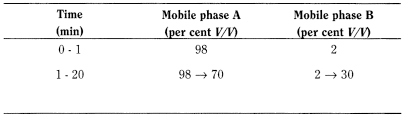
Flow rate 1.5 mL/min.
Detection Spectrophotometer at 220 nm.
Injection 20 µL of the test solution and reference solutions (c), (d), (e) and (f).
- — resolution: minimum 2.0 between the peaks due to impurities A and B in the chromatogram obtained with reference solution (c) and minimum 1.5 between the peaks due to cefalexin and cefotaxime in the chromatogram obtained with reference solution (f).
- — impurity B: not more than the area of the 2nd peak in the chromatogram obtained with reference solution (c) (1.0 per cent);
- — any other impurity: not more than the area of the 1st peak in the chromatogram obtained with reference solution (c) (1.0 per cent);
- — total: not more than 3 times the area of the 1st peak in the chromatogram obtained with reference solution (c) (3.0 per cent);
- — disregard limit: the area of the 2nd peak in the chromatogram obtained with reference solution (e) (0.05 per cent); disregard any peaks due to dimethylformamide or dimethylacetamide.
Maximum 20 ppm.
4.0 per cent to 8.0 per cent, determined on 0.300 g.
Maximum 0.2 per cent, determined on 1.0 g.
Liquid chromatography (2.2.29).
Test solution Dissolve 50.0 mg of the substance to be examined in water R and dilute to 100.0 mL with the same solvent.
Reference solution (a) Dissolve 50.0 mg of cefalexin monohydrate CRS in water R and dilute to 100.0 mL with the same solvent.
Reference solution (b) Dissolve 10 mg of cefradine CRS in 20 mL of reference solution (a) and dilute to 100 mL with water R.
- — size: l = 0.25 m, Ø = 4.6 mm;
- — stationary phase: octadecylsilyl silica gel for chromatography R (5 µm).
Mobile phase methanol R, acetonitrile R, 13.6 g/L solution of potassium dihydrogenphosphate R, water R (2:5:10:83 V/V/V/V).
Flow rate 1.5 mL/min.
Detection Spectrophotometer at 254 nm.
Injection 20 µL.
System suitability Reference solution (b):
- — resolution: minimum 4.0 between the peaks due to cefalexin and cefradine.
Calculate the percentage content of cefalexin monohydrate.
Protected from light.

A. (2R)-2-amino-2-phenylacetic acid (d-phenylglycine),
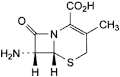
B. (6R,7R)-7-amino-3-methyl-8-oxo-5-thia-1-azabicyclo[4.2.0]oct-2-ene-2-carboxylic acid (7-aminodesacetoxycephalosporanic acid, 7-ADCA),
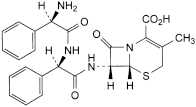
C. (6R,7R)-7-[[(2R)-2-[[(2R)-2-amino-2-phenylacetyl]amino]-2-phenylacetyl]amino]-3-methyl-8-oxo-5-thia-1-azabicyclo[4.2.0]oct-2-ene-2-carboxylic acid,

D. 3-hydroxy-4-methylthiophen-2(5H)-one,
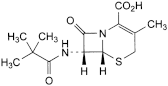
E. (6R,7R)-7-[(2,2-dimethylpropanoyl)amino]-3-methyl-8-oxo-5-thia-1-azabicyclo[4.2.0]oct-2-ene-2-carboxylic acid (7-ADCA pivalamide),
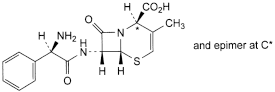
F. (2RS,6R,7R)-7-[[(2R)-2-amino-2-phenylacetyl]amino]-3-methyl-8-oxo-5-thia-1-azabicyclo[4.2.0]oct-3-ene-2-carboxylic acid (delta-2-cefalexin).
Ph Eur