- British Pharmacopoeia Volume I & II
- Monographs: Medicinal and Pharmaceutical Substances
Ketotifen Fumarate |
 |


(Ketotifen Hydrogen Fumarate, Ph Eur monograph 1592)
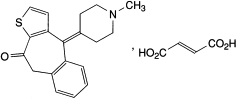
C19H19NOS,C4H4O4 425.5 34580-14-8
Histamine H1 receptor antagonist.
Ph Eur
4-(1-Methylpiperidin-4-ylidene)-4,9-dihydro-10H-benzo[4,5]cyclohepta[1,2-b]thiophen-10-one hydrogen (E)-butenedioate.
98.5 per cent to 101.0 per cent (dried substance).
White to brownish-yellow, fine, crystalline powder.
Sparingly soluble in water, slightly soluble in methanol, very slightly soluble in acetonitrile.
A. Infrared absorption spectrophotometry (2.2.24).
Comparison Ph. Eur. reference spectrum of ketotifen hydrogen fumarate.
B. Thin-layer chromatography (2.2.27).
Test solution Dissolve 40 mg of the substance to be examined in methanol R and dilute to 10 ml with the same solvent.
Reference solution Dissolve 11 mg of fumaric acid CRS in methanol R and dilute to 10 ml with the same solvent.
Plate cellulose for chromatography F254 R as the coating substance.
Mobile phase water R, anhydrous formic acid R, di-isopropyl ether R (3:7:90 V/V/V).
Application 5 µl.
Development Over a path of 17 cm.
Drying In a current of warm air.
Detection Examine in ultraviolet light at 254 nm. Spray lightly with a 5 g/l solution of potassium permanganate R in a 1.4 per cent V/V solution of sulphuric acid R. Examine in daylight by transparency.
Results The spot due to fumaric acid in the chromatogram obtained with the test solution is similar in position, colour and intensity to the principal spot in the chromatogram obtained with the reference solution.
The solution is clear (2.2.1) and not more intensely coloured than reference solution Y4, BY4 or B4 (2.2.2, Method II).
Dissolve 0.2 g in methanol R and dilute to 10 ml with the same solvent.
Liquid chromatography (2.2.29).
Test solution Dissolve 30.0 mg of the substance to be examined in a mixture of equal volumes of methanol R and water R and dilute to 100.0 ml with the same mixture of solvents.
Reference solution (a) Dilute 1.0 ml of the test solution to 50.0 ml with a mixture of equal volumes of methanol R and water R. Dilute 1.0 ml to 10.0 ml with a mixture of equal volumes of methanol R and water R.
Reference solution (b) Dissolve 3.0 mg of ketotifen impurity G CRS in 10 ml of methanol R and dilute to 20.0 ml with water R. Protect the solution from light.
Reference solution (c) To 1.5 ml of reference solution (b) add 1.0 ml of the test solution and dilute to 10.0 ml with a mixture of equal volumes of methanol R and water R. Protect the solution from light.
Reference solution (d) Dilute 0.5 ml of reference solution (b) to 50.0 ml with a mixture of equal volumes of methanol R and water R. Protect the solution from light.
- — size: l = 0.15 m, Ø = 4.0 mm;
- — stationary phase: octadecylsilyl silica gel for chromatography R (3 µm);
- — temperature: 40 °C.
- — mobile phase A: mix 175 µl of triethylamine R and 500 ml of water R;
- — mobile phase B: mix 175 µl of triethylamine R and 500 ml of methanol R,
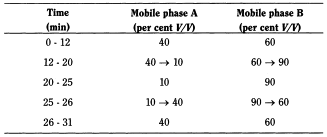
Flow rate 1.0 ml/min.
Detection Spectrophotometer at 297 nm.
Injection 20 µl; inject the test solution and reference solutions (a), (c) and (d).
Relative retentions with reference to ketotifen: impurity D = about 0.31; impurity C = about 0.61; impurity G = about 0.86; impurity E = about 1.18; impurity F = about 1.36; impurity B = about 1.72; impurity A = about 2.15.
- — resolution: minimum of 1.5 between the peaks due to ketotifen and to impurity G in the chromatogram obtained with reference solution (c);
- — signal-to-noise ratio: minimum of 70 for the principal peak in the chromatogram obtained with reference solution (d).
- — correction factor: for the calculation of contents, multiply the area of the corresponding peak by the following correction factor: impurity G = 1.36;
- — impurity G: not more than the area of the principal peak in the chromatogram obtained with reference solution (a) (0.2 per cent);
- — any impurity: not more than the area of the principal peak in the chromatogram obtained with reference solution (a) (0.2 per cent);
- — total: not more than 2.5 times the area of the principal peak in the chromatogram obtained with reference solution (a) (0.5 per cent);
- — disregard limit: 0.25 times the area of the principal peak in the chromatogram obtained with reference solution (a) (0.05 per cent).
Maximum 0.5 per cent, determined on 1.000 g by drying in an oven at 105 °C for 4 h.
Maximum 0.1 per cent, determined on 1.0 g.
Dissolve 0.350 g in a mixture of 30 ml of anhydrous acetic acid R and 30 ml of acetic anhydride R. Titrate with 0.1 M perchloric acid, determining the end-point potentiometrically (2.2.20).
1 ml of 0.1 M perchloric acid is equivalent to 42.55 mg of C23H23NO5S.
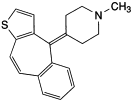
A. 4-(4H-benzo[4,5]cyclohepta[1,2-b]thiophen-4-ylidene)-1-methylpiperidine,
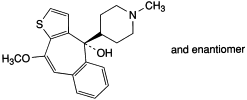
B. (4RS)-10-methoxy-4-(1-methylpiperidin-4-yl)-4H-benzo[4,5]cyclohepta[1,2-b]thiophen-4-ol,
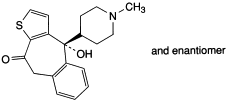
C. (4RS)-4-hydroxy-4-(1-methylpiperidin-4-yl)-4,9-dihydro-10H-benzo[4,5]cyclohepta[1,2-b]thiophen-10-one,
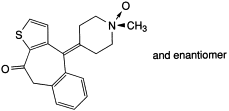
D. 4-[(aRaS)-1-methylpiperidin-4-ylidene]-4,9-dihydro-10H-benzo[4,5]cyclohepta[1,2-b]thiophen-10-one N-oxide (ketotifen N-oxide),
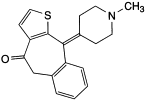
E. 10-(1-methylpiperidin-4-ylidene)-5,10-dihydro-4H-benzo[5,6]cyclohepta[1,2-b]thiophen-4-one,
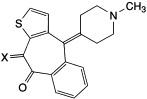
F. X = H2: 4-(1-methylpiperidin-4-ylidene)-4,10-dihydro-9H-benzo[4,5]cyclohepta[1,2-b]thiophen-9-one,
G. X = O: 4-(1-methylpiperidin-4-ylidene)-4H-benzo[4,5]cyclohepta[1,2-b]thiophen-9,10-dione.
Ph Eur