- British Pharmacopoeia Volume I & II
- Monographs: Medicinal and Pharmaceutical Substances
Sulfacetamide Sodium |
 |


Soluble Sulfacetamide
(Ph Eur monograph 0107)
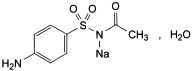
C8H9N2NaO3S,H2O 254.2 6209-17-2
Sulfonamide antibacterial.
Ph Eur
Sodium acetyl[(4-aminophenyl)sulphonyl]azanide.
99.0 per cent to 101.0 per cent (anhydrous substance).
White or yellowish-white, crystalline powder.
Freely soluble in water, slightly soluble in anhydrous ethanol.
First identification B, F.
Second identification A, C, E, F.
A. Ultraviolet and visible absorption spectrophotometry (2.2.25).
Test solution Dissolve 0.1 g in phosphate buffer solution pH 7.0 R and dilute to 100.0 ml with the same buffer solution. Dilute 1.0 ml of this solution to 100.0 ml with phosphate buffer solution pH 7.0 R.
Spectral range 230-350 nm.
Absorption maximum At 255 nm.
Specific absorbance at the absorption maximum 660 to 720 (anhydrous substance).
B. Infrared absorption spectrophotometry (2.2.24).
Comparison sulfacetamide sodium CRS.
C. Melting point (2.2.14): 181 °C to 185 °C.
Dissolve 1 g in 10 ml of water R, add 6 ml of dilute acetic acid R and filter. Wash the precipitate with a small quantity of water R and dry at 100-105 °C for 4 h.
E. Dissolve about 1 mg of the precipitate obtained in identification C, with heating, in 1 ml of water R. The solution gives the reaction of primary aromatic amines (2.3.1) with formation of an orange-red precipitate.
F. Solution S (see Tests) gives the reactions of sodium (2.3.1).
Dissolve 1.25 g in carbon dioxide-free water R and dilute to 25 ml with the same solvent.
Solution S is clear (2.2.1) and not more intensely coloured than reference solution GY4 (2.2.2, Method II).
8.0 to 9.5 for solution S.
Liquid chromatography (2.2.29). Prepare the solutions immediately before use and carry out the test protected from light.
Test solution Dissolve 0.200 g of the substance to be examined in the mobile phase and dilute to 10.0 ml with the mobile phase.
Reference solution (a) Dissolve 5 mg of sulfacetamide sodium CRS and 5 mg of sulfanilamide R (impurity A) in 1.0 ml of the mobile phase.
Reference solution (b) Dilute 1.0 ml of the test solution to 100.0 ml with the mobile phase. Dilute 1.0 ml of this solution to 10.0 ml with the mobile phase.
- — size: l = 0.125 m, Ø = 4 mm;
- — stationary phase: end-capped octadecylsilyl silica gel for chromatography R (5 µm).
Mobile phase glacial acetic acid R, methanol R, water for chromatography R (1:10:89 V/V/V).
Flow rate 0.8 ml/min.
Detection Spectrophotometer at 254 nm.
Injection 10 μl.
Run time 7 times the retention time of sulfacetamide.
Relative retention With reference to sulfacetamide (retention time = about 5 min): impurity A = about 0.5.
System suitability Reference solution (a):
- — resolution: minimum 5.0 between the peaks due to impurity A and sulfacetamide.
- — correction factor: for the calculation of the content, multiply the peak area of impurity A by 0.5;
- — impurity A: not more than twice the area of the principal peak in the chromatogram obtained with reference solution (b) (0.2 per cent);
- — unspecified impurities: for each impurity, not more than the area of the principal peak in the chromatogram obtained with reference solution (b) (0.10 per cent);
- — total: not more than 5 times the area of the principal peak in the chromatogram obtained with reference solution (b) (0.5 per cent);
- — disregard limit: 0.5 times the area of the principal peak in the chromatogram obtained with reference solution (b) (0.05 per cent).
Maximum 200 ppm.
Dissolve 2.5 g in distilled water R and dilute to 25 ml with the same solvent. Add 25 ml of dilute acetic acid R, shake for 30 min and filter. 15 ml of the filtrate complies with the limit test for sulphates.
Maximum 20 ppm.
12 ml of the filtrate obtained in the test for sulphates complies with test A. Prepare the reference solution using lead standard solution (1 ppm Pb) R.
6.0 per cent to 8.0 per cent, determined on 0.200 g.
Dissolve 0.500 g in a mixture of 50 ml of water R and 20 ml of dilute hydrochloric acid R. Cool the solution in a bath of iced water and carry out the determination of primary aromatic amino-nitrogen (2.5.8), determining the end-point electrometrically.
1 ml of 0.1 M sodium nitrite is equivalent to 23.62 mg of C8H9N2NaO3S.
Protected from light.
Specified impurities A.
Other detectable impurities (The following substances would, if present at a sufficient level, be detected by one or other of the tests in the monograph. They are limited by the general acceptance criterion for other/unspecified impurities and/or by the general monograph Substances for pharmaceutical use (2034). It is therefore not necessary to identify these impurities for demonstration of compliance. See also 5.10. Control of impurities in substances for pharmaceutical use): B, C, D.
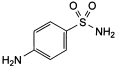
A. sulfanilamide,
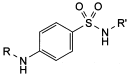
B. R = CO-CH3, R′ = H: N-(4-sulphamoylphenyl)acetamide,
C. R = R′ = CO-CH3: N-[[4-(acetylamino)phenyl]sulphonyl]acetamide,
D. dapsone.
Ph Eur