Quazepam Tablets
» Quazepam Tablets contain not less than 90 percent and not more than 110.0 percent of quazepam (C17H11ClF4N2S).
Packaging and storage—
Preserve in a well-closed container.
USP Reference standards  11
11 —
—
USP Ethylparaben RS .
.
USP Quazepam RS.
USP Quazepam Related Compound A RS.
11—
USP Ethylparaben RS
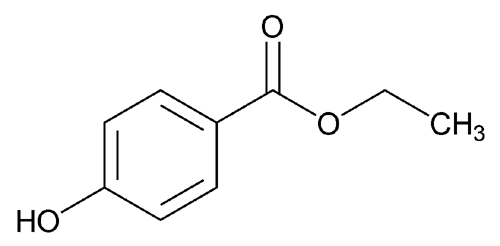 .
.
USP Quazepam RS.
USP Quazepam Related Compound A RS.
Identification—
A:
The retention time of the major peak in the chromatogram of the Assay preparation corresponds to that in the chromatogram of the Standard preparation, both relative to the internal standard as obtained in the Assay.
B:
The RF value of the principal spot in the chromatogram of the Test solution obtained in the test for Related compounds corresponds to that in the chromatogram of Standard solution A.
Dissolution 711—
711—
Medium:
1% sodium lauryl sulfate; 900 mL.
Apparatus 2:
50 rpm.
Time:
30 minutes.
Procedure—
Determine the amount of C17H11ClF4N2S dissolved from UV absorbances at the wavelength of maximum absorbance at about 287 nm on filtered portions of the solution under test in comparison with a Standard solution having a known concentration of USP Quazepam RS dissolved in a small volume of methanol and diluted with Dissolution Medium.
Tolerances—
Not less than 80% (Q) of the labeled amount of C17H11ClF4N2S is dissolved in 30 minutes.
Uniformity of dosage units 905:
meet the requirements.
905:
meet the requirements.
Related compounds—
Test solution—
Grind 10 Tablets to a fine powder. Dissolve an accurately weighed portion of the powder in methylene chloride to obtain a solution having a concentration of 10 mg of quazepam per mL. Mix for 30 minutes, and centrifuge.
Standard solution A—
Dissolve an accurately weighed quantity of USP Quazepam RS in methylene chloride to obtain a solution having a known concentration of about 10 mg per mL.
Standard solution B—
Dissolve an accurately weighed quantity of USP Quazepam RS in methylene chloride to obtain a solution having a known concentration of about 0.04 mg per mL (0.2%).
Standard solution C—
Dissolve an accurately weighed quantity of USP Quazepam Related Compound A RS in methylene chloride to obtain a solution having a known concentration of about 0.3 mg per mL (1.5%).
Procedure—
Separately apply 10 µL each of the Test Solution and Standard solution A and 5 µL each of Standard solutions B and C to a thin-layer chromatographic plate (see Chromatography 621) coated with a 0.25-mm layer of chromatographic silica gel. Allow the spots to dry, and develop the chromatogram in a solvent system consisting of a mixture of cyclohexane, ethyl acetate, and ether (170:40:25) in a paper-lined tank until the solvent front has moved about three-fourths of the length of the plate. Remove the plate from the developing chamber, mark the solvent front, allow to air-dry, and examine the plate under short-wavelength UV light. Compare the intensity of the secondary spot in the chromatogram of the Test solution having the same RF value as the principal spot in the chromatogram of Standard solution C. The spot is not larger or more intense than the principal spot obtained from Standard solution C. Compare the intensities of any additional secondary spots observed in the chromatogram of the Test solution with that of the principal spot in the chromatogram of Standard solution B: no additional secondary spot from the chromatogram of the Test solution is larger or more intense than the principal spot obtained from Standard solution B, and the sum of the intensities of the additional secondary spots obtained from the Test solution is not more than 0.6%.
621) coated with a 0.25-mm layer of chromatographic silica gel. Allow the spots to dry, and develop the chromatogram in a solvent system consisting of a mixture of cyclohexane, ethyl acetate, and ether (170:40:25) in a paper-lined tank until the solvent front has moved about three-fourths of the length of the plate. Remove the plate from the developing chamber, mark the solvent front, allow to air-dry, and examine the plate under short-wavelength UV light. Compare the intensity of the secondary spot in the chromatogram of the Test solution having the same RF value as the principal spot in the chromatogram of Standard solution C. The spot is not larger or more intense than the principal spot obtained from Standard solution C. Compare the intensities of any additional secondary spots observed in the chromatogram of the Test solution with that of the principal spot in the chromatogram of Standard solution B: no additional secondary spot from the chromatogram of the Test solution is larger or more intense than the principal spot obtained from Standard solution B, and the sum of the intensities of the additional secondary spots obtained from the Test solution is not more than 0.6%.
Assay—
Mobile phase—
Prepare a filtered and degassed mixture of methanol and water (7:3). Make adjustments, if necessary (see System Suitability under Chromatography 621).
621).
Internal standard solution—
Dissolve an accurately weighed quantity of USP Ethylparaben RS in methanol, and dilute quantitatively, and stepwise if necessary, with methanol to obtain a solution containing about 0.19 mg per mL.
Standard preparation—
Dissolve an accurately weighed quantity of USP Quazepam RS in Internal standard solution, and dilute quantitatively, and stepwise if necessary, with Internal standard solution to obtain a solution having a known concentration of about 1.5 mg of quazepam per mL.
Assay preparation—
Weigh and finely powder not fewer than 10 Tablets. Transfer an accurately weighed portion of powder, equivalent to about 15 mg of quazepam, to a 50-mL screw-capped centrifuge tube. Add 10.0 mL of Internal standard solution, and centrifuge for 30 minutes.
Chromatographic system (see Chromatography 621)—
The liquid chromatograph is equipped with a 254-nm detector and a 4.6-mm × 25-cm column that contains packing L7. The flow rate is about 1.5 mL per minute. Chromatograph the Standard preparation, and record the peak responses as directed for Procedure: the resolution, R, between ethylparaben and quazepam is not less than 5.5; and the relative standard deviation for replicate injections is not more than 2.0%. [note—For identification purposes, the relative retention times are about 0.4 for ethylparaben and 1.0 for quazepam.]
621)—
The liquid chromatograph is equipped with a 254-nm detector and a 4.6-mm × 25-cm column that contains packing L7. The flow rate is about 1.5 mL per minute. Chromatograph the Standard preparation, and record the peak responses as directed for Procedure: the resolution, R, between ethylparaben and quazepam is not less than 5.5; and the relative standard deviation for replicate injections is not more than 2.0%. [note—For identification purposes, the relative retention times are about 0.4 for ethylparaben and 1.0 for quazepam.]
Procedure—
Separately inject equal volumes (about 5 µL) of the Standard preparation and the Assay preparation into the chromatograph, record the chromatograms, and measure the responses for the major peaks. Calculate the quantity, in mg, of quazepam (C17H11ClF4N2S) in the portion of Tablets taken by the formula:
10C(RU / RS)
in which C is the concentration, in mg per mL, of USP Quazepam RS in the Standard preparation; and RU and RS are the ratios of the peak response of quazepam to that of ethylparaben obtained from the Assay preparation and the Standard preparation, respectively.
Auxiliary Information—
Please check for your question in the FAQs before contacting USP.
Chromatographic Column—
| Topic/Question | Contact | Expert Committee |
| Monograph | Ravi Ravichandran, Ph.D.
Senior Scientist 1-301-816-8330 |
(MDPP05) Monograph Development-Psychiatrics and Psychoactives |
| Reference Standards | Lili Wang, Technical Services Scientist 1-301-816-8129 RSTech@usp.org |
|
| 711 |
Margareth R.C. Marques, Ph.D.
Senior Scientist 1-301-816-8106 |
(BPC05) Biopharmaceutics05 |
USP32–NF27 Page 3457
Pharmacopeial Forum: Volume No. 32(2) Page 370
Chromatographic columns text is not derived from, and not part of, USP 32 or NF 27.